
Housing stakeholders debate 8-30g counting rules, accept report for further comment
Get AI-powered insights, summaries, and transcripts
Sign Up Free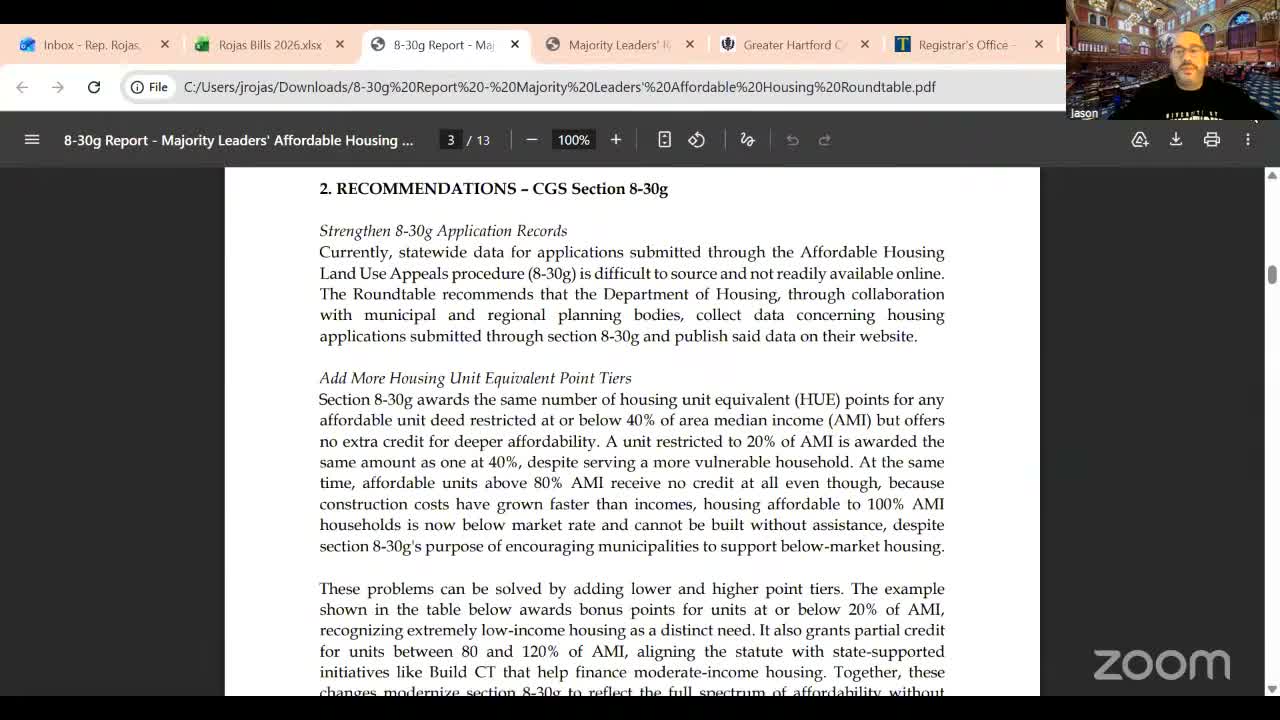
Summary
Participants in a virtual housing working meeting debated proposed changes to how Connecticut counts affordable units under 8-30g — including SROs, naturally occurring affordable units, and new income tiers — and agreed to accept a draft report for public comment and revision.
Participants in a virtual housing working-group meeting debated proposed changes to state policy under the 8-30g statute and accepted a draft report for submission and public comment, members said.
The session focused on three policy areas: data collection and verification, what housing types should count toward the 10% eligibility threshold, and whether to recognize single-room-occupancy (SRO) units and additional income tiers for municipal credit. The meeting facilitator circulated an updated report in advance and invited comments and edits before public hearings or committee debate.
Why it matters: 8-30g eligibility determines when municipalities can use the state's affordable housing law and affects municipal zoning and developers' incentives. Changes to what counts as affordable housing or to the threshold itself would shift which communities qualify for exemptions and could change how municipalities plan for both deeply affordable and workforce housing.
DOH staff framed the 10% list as an administrative, verifiable threshold rather than a needs assessment. "10% is not a needs number. 10% is simply an eligibility threshold," said Michael Santoro of the Department of Housing, explaining that the department counts CHFA mortgages, rental assistance certificates and deed-restricted assisted housing because those items are readily verifiable in existing data systems. He warned that adding new categories to be counted would effectively move the eligibility needle rather than demonstrate community need.
Technical staff and advocates pressed whether municipalities should get credit for naturally occurring affordable housing (NOAH) and for a wider range of income bands. David, a technical commenter, warned that some proposed inclusions could produce perverse incentives: "You wouldn't want to create the possibility of incentivizing nonservice oriented SRO units," he said, urging a tighter definition of SROs and a restriction that assisted housing counted toward the numerator should be limited to units at or below 80% of area median income.
Francis, another participant, argued that the current statute does not recognize deeper affordability and workforce housing well enough: "We do have a need for deeply affordable housing, which is not currently accounted for under 8-30g," he said, and suggested adding additional tiers so municipalities could earn credit for a broader set of affordable units.
Participants also raised equity and availability concerns: some mortgage and subsidy products that are counted in certain towns are not available statewide, which can produce inconsistent counting between municipalities. Several speakers urged caution about shortening statutory review periods (for example, reducing the 90-day window) because that could increase administrative burdens on towns.
Next steps: The group's facilitator said the body would accept the report for further editing and public comment and invited members to send additions to Trent, who circulated the updated draft. The transcript does not record a formal roll-call vote; the acceptance was moved and advanced by voice/consensus in the meeting. Trent asked participants to submit edits for inclusion before the report is finalized and released for public hearings.
The meeting closed with housekeeping items and no formal vote tally was recorded in the transcript.