
Committee sends bill to replace federal Grad PLUS gap with state-backed graduate loans
Get AI-powered insights, summaries, and transcripts
Subscribe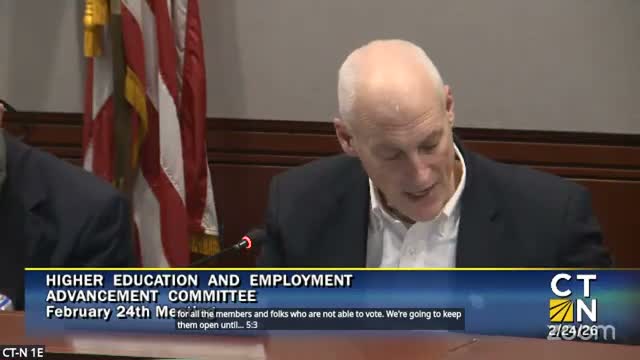
Summary
SB 8 was moved JFS to the floor with language extending the program runway; sponsors said the bill aims to replace low-interest Grad PLUS lending lost after HR 1 and to preserve graduate access to training in fields such as nursing and teaching.
The Higher Education Employment Advancement Committee voted to send SB 8, a proposal to support graduate students with state-backed, low-interest loans, to the House floor with JFS language that extends bond authorization to provide a longer runway for the program.
Chair summarized the urgency: “the federal grad student loan plus program was eliminated in HR 1, which means that, eventually, cumulatively, about $90,000,000 in low interest loans for Connecticut graduate students will be going away if we do nothing,” he said, and described the JFS language as expanding the bond authorization beyond a single year to avoid a near-term funding gap.
Representative Branca praised the plan for filling the gap and suggested the committee consider a residency requirement — for example, requiring loan recipients to live and work in Connecticut for five years after graduation — so the state derives long-term workforce benefits from the investment. Chair and others noted the program is structured as loans that will be repaid and that some institutions (the chair said Yale) do not intend to participate; supporters stressed the program’s importance for low-income, first-generation and workforce-critical graduate students.
The clerk called roll to send SB 8 (LCO 2084) JFS to the floor; the record showed a majority of members voting yes and the clerk held votes open until 05:30 for members not present. The bill will proceed to the floor and, if passed, provide an alternative source of low-interest graduate loans meant to replace federal options removed by HR 1.
Sponsoring members said additional program details — including precise bond amounts beyond the originally contemplated one‑year authorization — will be finalized in subsequent budget and floor-phase work.