
Committee refines H.559 language to create parole-board legal-counsel pilot; funding questions remain
Get AI-powered insights, summaries, and transcripts
Subscribe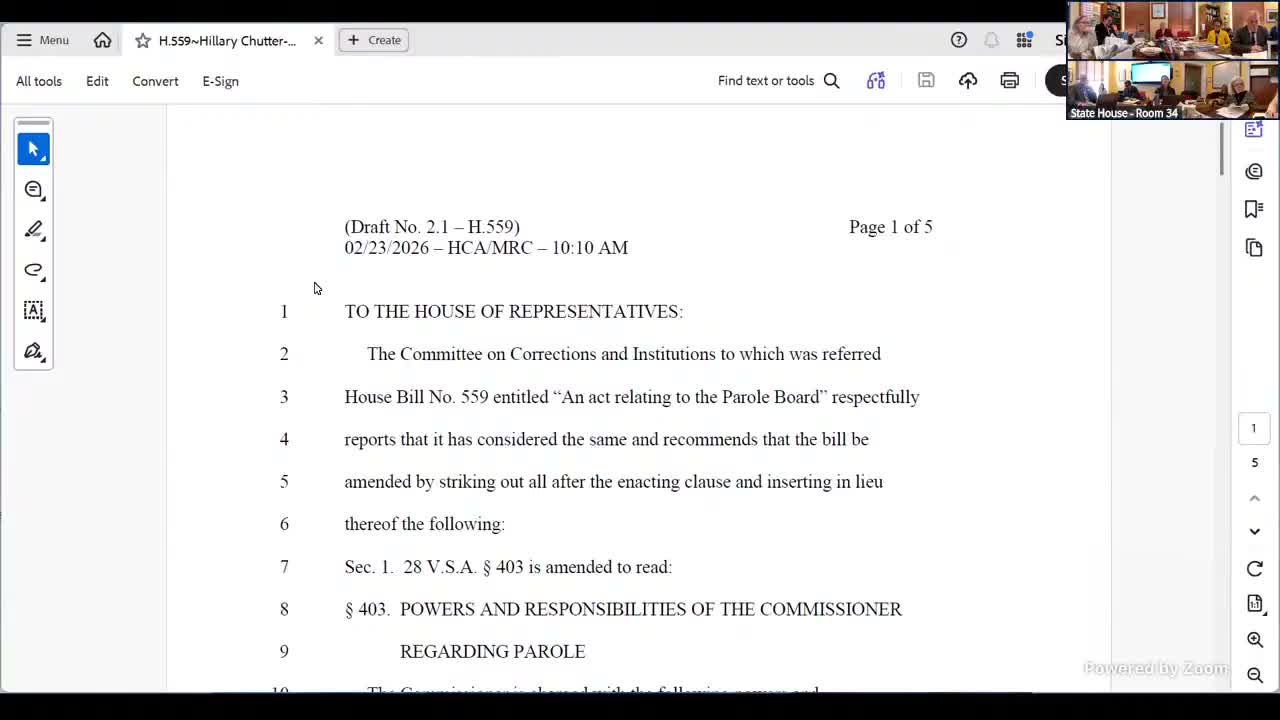
Summary
The House Corrections and Institutions Committee reviewed draft language for H.559 to create a parole-board legal-counsel pilot to provide annual training and on-call legal advice; members agreed the AGO, parole board and Agency of Human Services should coordinate contracting but debated whether $25,000 is sufficient and whether to seek $50,000–$75,000 in additional funds.
The House Corrections and Institutions Committee reviewed revised draft language for H.559 on Tuesday, directing staff to broaden the pilot’s training scope while leaving final decisions about procurement and funding to a follow-up appropriations discussion.
Hillary Cutter Ames of the Office of Legislative Council told the panel the bill’s new Section 4 would create “a parole board legal counsel pilot project” to provide external legal support for annual training and “legal advice to the board as needed related to board hearings,” and assigns coordination to the Office of the Attorney General, the parole board, and the Agency of Human Services. Ames said the draft also asks the parole board director to submit a written report on the pilot; the committee agreed to a revised deadline for that report.
The proposal is intended to give parole-board members additional legal backing for due-process matters and parole-violation hearings, and to let the board document budget needs for future fiscal years. “Annual training to the board, including on topics related to due process and parole violations,” Ames said, as a drafting formulation the committee favored because it preserves the emphasis on due process while allowing a broader slate of training topics.
Members pressed officials for details on who would issue the solicitation for outside counsel. An attorney from the AGO said the procurement would likely use a simplified bid process drawing on language from existing contracts for similar small boards; the AGO also flagged that subsection 4(b), which says the AGO “shall coordinate” contracting, may duplicate existing AGO sign-off requirements. The committee instructed staff to reconcile that redundancy in the next draft.
Parole-board director Mary Jane Ainsworth said the two main training topics initially are due process and parole violations but that the board could add other topics as needed. “I think our two main topics are these to start off with, but definitely could look at other topics as well,” Ainsworth said, and urged keeping the broad “legal advice” language so counsel can assist with statutory and rule-based questions beyond hearings.
Committee members focused heavily on money. Members and staff confirmed there is $25,000 in the fiscal 2026 DOC budget that had been zeroed out in fiscal 2027; several lawmakers said $25,000 is unlikely to attract bidders or cover both training and on-call advice. Multiple members proposed asking appropriations for a larger sum and agreed to try to locate up to $50,000 more within the larger DOC budget so that a $75,000 pilot appropriation could be requested. One member summarized the concern: parole-board decisions affect individual liberty and public safety in a way that “warrants more legal backup than some of these smaller boards.”
Laurie Fisher, general counsel at the Department of Corrections, said DOC supports removing DOC from certain contracting language where that change protects the parole board’s statutory independence. “I think the goal is to get the parole board their independence that statutorily they're supposed to have,” Fisher said, while adding DOC can help with implementation and the report on the pilot.
On process, the committee asked the Office of Legislative Council to draft an appropriation section if the committee decides on an amount above the existing allocation. Hillary Cutter Ames said appropriations language will be necessary if the committee aims to move beyond the $25,000 currently available. The committee also asked staff to reconcile which entity will formally issue the solicitation and to remove or rework any language that duplicates existing AGO responsibilities.
The committee agreed to circulate revised draft language before a follow-up session on Thursday and to reach out to the parole-board chair, Laurie Fisher (DOC), and the AGO for input. The panel did not take a formal vote on the bill during the session; members instead directed staff to refine the text, clarify the contracting pathway, and try to identify additional funding ahead of the appropriations review.