Efficiency Standards, Transmission Oversight and Bill Redesign Draw Attention in Committee
Loading...
Summary
Witnesses urged the committee to preserve appliance efficiency standards (HB 5248), give the Connecticut Siting Council more forward‑looking transmission authority, and study residential bill redesign (SB 243) to increase transparency about what drives rates.
Multiple witnesses urged the Energy and Technology Committee to strengthen energy efficiency policy and transmission planning and to study how residential electric bills are presented to customers.
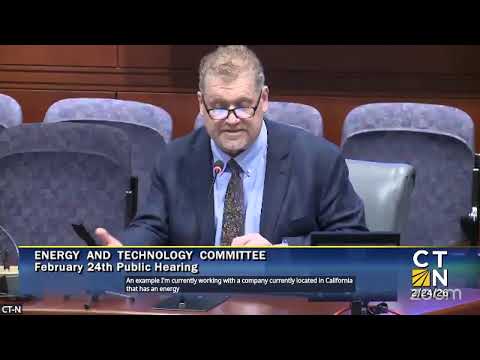
A testifier (Carrie) opened by emphasizing the NEVI program for EV charging and the role state facilitation can play; she backed HB 5248’s energy efficiency standards and urged Connecticut to prepare in case the Energy Star program changes. "Preserving energy efficiency standards should be a crucial part of Connecticut's energy planning," she said and noted transmission charges can represent "almost 13%" of a ratepayer's total electricity bill (in some cases as much as 15%).
Christy Prescott, vice president of regulatory at United Illuminating, supported giving the Connecticut Siting Council clearer authority to consider long‑term transmission needs (section 5 of HB 5248) but cautioned about operational and consumer protection implications on other bills. Prescott also described UI's 2024 residential bill redesign and cautioned against a rushed redesign before customers acclimate to the current layout.
Tom Swan (Connecticut Citizen Action Group) and Andy Bauer (Portland Clean Energy Task Force) urged the committee to separate or better explain the public benefits charge on bills so ratepayers can see program impacts. Swan criticized what he termed aggressive corporate profits by Eversource and said breaking out charges would prevent misattribution of high rates to energy assistance programs.
Lawmakers asked detailed questions about demand charges for agricultural customers, how maximum daily quantity (MDQ) is set and adjusted, and the data needed to analyze whether shortening supplier switching windows would shift costs between customers. Witnesses described the MDQ process (set at account establishment using expected usage; the highest day November–March can be used to set levels) and noted billing systems lack a reliable agricultural account identifier, which could complicate any changes focused on that customer class.
What happens next: Committee members signaled interest in a study to quantify the bill‑design, demand‑charge and switching timelines impacts; no vote occurred during the hearing.
Sources and attributions: Testimony from Carrie, Christy Prescott (United Illuminating), Tom Swan (Connecticut Citizen Action Group), Andy Bauer and others provided the basis for this summary.