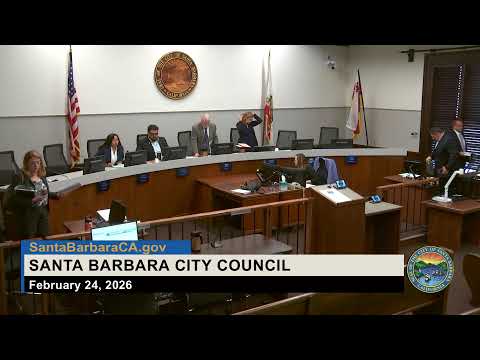
Santa Barbara council hears widening budget gap, approves Q2 adjustments and budget schedule
Loading...
Summary
City staff warned of a structural general‑fund shortfall and projected reserve depletion by fiscal 2028; the council accepted Q2 budget adjustments and directed staff to refine options including potential revenue measures for a Nov. 2026 ballot.
City Council on Feb. 24 accepted a midyear financial review that shows a growing multiyear deficit and a need for both revenue and expenditure solutions.
Council member and finance committee member Eric Friedman summarized the committee briefing, saying “staff is projecting a $5,900,000 deficit for this fiscal year,” and said the committee forwarded budget adjustments and salary changes to the full council.
Finance Director Keith Demartini and staff walked the council through a multiyear forecast that shows general‑fund expenditures outpacing revenues. Demartini said staff’s projection indicates the city could “fully deplete all of our general fund reserves by the end of fiscal year 2028” if no additional actions are taken. Presenters outlined a four‑part balancing approach for FY27 that relies on tier‑1 savings and revenue measures, temporary vacancy savings, and other cost reductions.
Options discussed include fee adjustments, shifting eligible positions to enterprise funds, and several potential ballot measures for November 2026. Staff presented modeling for a real‑property transfer tax that would apply only to properties selling for $3 million or more (estimated to generate about $5.1 million annually if approved) and an increase in the transient occupancy tax (modeled to add roughly $5.8 million annually). Staff said any ballot measure revenue would not take effect before Jan. 1, 2027.
Council members pressed for greater clarity on what portion of large capital figures are actual cash expenditures versus encumbrances for multiyear projects. Controller Natalie Liccoli agreed to provide more granular reporting on encumbrances and the portion of project costs expected to be spent in 2026.
Members also asked how non‑general‑fund risks — such as waterfront dredging that staff estimated at about $4 million annually if federal funding lapses — would affect the general fund. Staff said the waterfront enterprise fund is the first backstop but that the general fund would ultimately be responsible if the enterprise fund could not cover dredging costs.
After questions and discussion, Council member Jordan moved and the council approved the staff recommendations to accept the Q2 report and adopt the related resolutions. The motion passed unanimously; Council member Harmon was recorded absent for the final vote.
Next steps: staff will return with additional detail on encumbrances and spend timing, and council will consider direction on which revenue measures to pursue before the March budget schedule items and the formal budget hearings later in spring.