
Residents press Hood County for a pause on data centers; court rejects reconsideration but asks state to act
Get AI-powered insights, summaries, and transcripts
Sign Up Free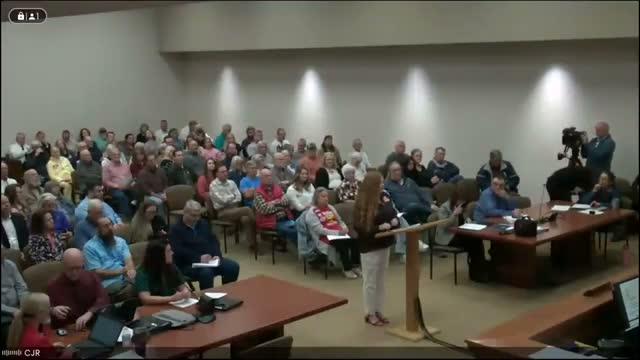
Summary
Hundreds of residents urged the Hood County Commissioners Court to impose a temporary moratorium on large data centers and associated power plants over concerns about water, noise and infrastructure. After hours of testimony, the court voted 3–2 against reconsidering moratorium language but unanimously adopted a resolution asking the governor to call a special session.
Hundreds of Hood County residents packed the Ralph H. Walton Jr. Justice Center on Feb. 24 to urge the Hood County Commissioners Court to pause approvals for large data centers and co-located power plants until the county can adopt stronger development regulations.
Public commenters told the court that proposed projects threaten the county’s water supply, create persistent industrial noise, strain roads and the electric grid, and could permanently change the character of rural precincts. "Hood County will not get a dime," said Shauna Whalen, who accused one developer of making conflicting job and water-use promises and called the proposals "a travesty." Dominique Inge told the court that conditional approvals provide a "point of entry" for investors and urged an outright moratorium. Cindy Highsmith, who has led repeated complaints about ongoing noise from local facilities, said the community needs time to set rules and protections before more projects are accepted.
Experts and residents quoted studies, local water-board votes and regulatory gaps. John Highsmith described a Feb. 18 vote by the Acton Municipal Utility District board that declined Pacifico Energy’s water request and asked the commissioners to recognize AMUD’s decision. Engineering and environmental speakers recommended baseline environmental sampling and independent review of drainage and groundwater impacts.
Commissioners debated the legal reach of Local Government Code chapter 231, Subchapter K — a Hood County–specific statute intended to protect the Brazos River watershed and Lake Granbury. Commissioner Andrews and outside counsel urged caution, citing case law and attorney advice that counties lack a general moratorium power. "The short answer is, no," Andrews said, urging the court to rely on express statutory authorities rather than a broad moratorium. Commissioner Eagle and other supporters argued the statute and the county’s watershed duties provide tools to act and said a temporary pause is necessary to avoid irreversible impacts.
After extended deliberation, Commissioner Samuelson moved to reconsider adopting an order that would have provided moratorium language and a temporary pause; the motion failed, with the chair announcing, "The nays have it 3 to 2." The court thereby did not reinstate the moratorium language as presented on Feb. 10.
While the court declined to reinstate the moratorium order, members unanimously approved a separate resolution asking Governor Greg Abbott to call a special legislative session to address the rapid growth of data centers statewide and to consider reforms on grid, water and permitting matters. Commissioner Samuelson said copies of the resolution will be sent to state leaders and relevant agencies.
Votes at a glance
- Replat: Landings East (Lot 3759R + 3760R -> 3759R2) — Approved 5–0 (replat approved). - Concept plan: Bella Village (Precinct 3, ~71 lots) — Approved 5–0 (concept plan approved). - Fire-department capital requests (Station 20) — Court denied two specified items (Lifepak monitor and Groves locker system) and tabled remainder; motion carried unanimously. - RFB 2026-02 corrugated steel culverts — Awarded to Wilson Culvert, Inc.; motion carried unanimously 5–0. - City of Granbury Founders Day event application — Authorized; motion carried unanimously 5–0. - Rifle-resistant body armor grant resolution — Authorized for county judge signature; motion carried unanimously 5–0. - Transfer of used Tahoe from sheriff to Mission Granbury — Approved unanimously. - Animal-control sidewalk (donor-funded, Road Ops labor) — Approved unanimously. - Radio consultant RFQ — Court advanced top four firms for interviews on March 9. - Vendor payments certified ($736,332.22) — Approved 5–0.
Why it matters
Speakers emphasized that decisions made now will affect water availability, wildlife habitat and the county’s rural character for decades. Many asked the court for time to craft enforceable, defensible rules — or for state lawmakers to step in. The court’s resolution asking the governor to convene a special session signals that county leaders are seeking a statewide solution, even as they differed about the county’s ability to impose a local moratorium.
What’s next
The court directed staff and counsel to continue work on development-regulation amendments; the development commission’s proposed rules are scheduled for further consideration on March 10. County staff will also follow up on the March 9 interviews for the radio consultant and on next steps to implement clarified development standards anchored in Subchapter K and related county authority.