Get Full Government Meeting Transcripts, Videos, & Alerts Forever!
Get email alerts on the Inspector General Establishment topic
No spam. Unsubscribe anytime.
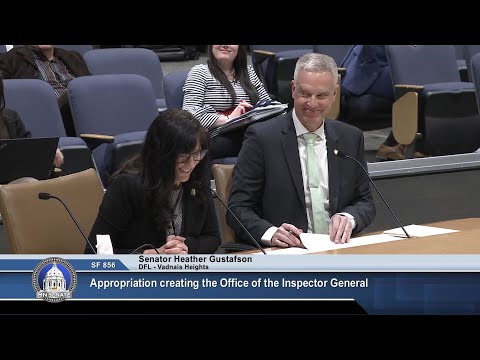
Senate committee approves amended bill to create independent Minnesota Office of Inspector General
Summary
The State and Local Government committee adopted amendments and recommended Senate File 856 to establish an independent Office of Inspector General to investigate fraud and refer cases to appropriate authorities; sponsors and members debated powers, appointment mechanics and timelines.
Senators on the Committee on State and Local Government and Veterans voted to recommend passage of Senate File 856 as amended, a measure to create an independent Office of Inspector General (OIG) for Minnesota aimed at strengthening oversight of state programs and reducing fraud.
Senator Karla Gustafson, the bill’s sponsor, told the committee the OIG would “ensure accountability, transparency, and fiscal responsibility in state government,” and called the office a bipartisan solution to protect taxpayer dollars. She and co‑presenter Senator Croon described a structure that places the OIG in the executive branch while shielding appointment authority through bipartisan legislative participation and final selection by the chief administrative law judge at the Office of Administrative Hearings (OAH).
The adopted A7 delete‑all amendment — later amended by an A8 revision addressing open‑meeting requirements for the legislative advisory commission — remained central to committee discussion. The bill, as described by sponsors, would require the Office of Legislative Auditor (OLA) to refer public tips about potential fraud to the OIG, establish minimum qualifications and a legislative inspector general advisory commission to recommend candidates, and permit the OIG subpoena authority and other auxiliary powers for inspections and investigations.
Committee members pressed sponsors on key operational details. Senator Justin Kranz and others asked whether subpoena authority and two licensed peace officers cited in the bill would be sufficient to investigate crimes requiring warrants or surveillance. Senator Gustafson and Senator Croon said those operational definitions would be refined in subsequent Judiciary Committee work and noted the bill intentionally left some referral language flexible so the OIG could send cases to the appropriate prosecutorial authority on a case‑by‑case basis.
Several members sought clearer delineation between the OLA’s existing role and the proposed OIG’s functions. Senator Kuran said the OLA performs systemwide audits and special reviews, while the OIG would focus on investigations of specific providers and recipients. Testimony from a public witness, Rich Neumeister, urged clearer language about what the OIG would and would not take from existing agencies, how finalists for appointment would be made public, and how data retention and privacy rules would be handled.
Sponsors specified major dates in the bill: advisory commission appointments are to be made by Aug. 1, 2025; the commission must convene by Sept. 15, 2025; the inspector general must be appointed by Jan. 1, 2026; and the OIG must be operational by Sept. 1, 2026. The bill authorizes staffing and resources, including two licensed peace officers, and allows the chief administrative law judge to contract for external quality assurance reviews every three years.
The committee’s voice vote recommended Senate File 856 as amended to pass and re‑referred the bill to the Judiciary Committee for further vetting of law‑enforcement powers, data practices, and other implementation details. The transcript shows a voice vote but does not record a roll‑call tally.