Get email alerts on the Council Actions topic
No spam. Unsubscribe anytime.
Votes at a glance: appointments, parking changes and administrative authorizations approved
Summary
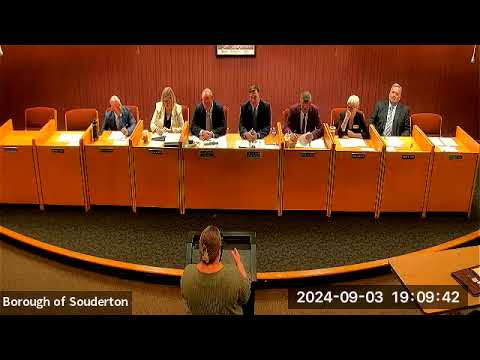
At its Sept. 3 meeting Soudersbury Borough Council approved several resolutions and administrative motions including police-committee appointments, a right-to-know officer designation, two dedicated handicap parking spaces, tax-collection committee designees and authorization for a PennDOT winter-maintenance signatory.
Souderton Borough Council approved a package of resolutions and appointments on Sept. 3. Key outcomes included:
- Police-committee appointments: Council appointed councilors (motion recorded) to serve on the police committee that hears grievance appeals under the collective-bargaining agreement.
- Right-to-Know officer: Council adopted Resolution 2024-19 appointing Sarah Jarrett Eaton as the borough's Right-to-Know Officer.
- Handicap parking: Council approved Resolution 2024-20 to add a dedicated handicap parking space at 211 East Summit Street and Resolution 2024-21 to add a dedicated handicap parking space at 126 East 7th Street; council discussed procedural considerations and neighborhood impact before voting.
- Tax-collection committee designees: Council approved Resolution 2024-22 appointing Sarah and Christine (names are recorded in the resolution text) as the borough designees to the Montgomery County tax-collection committee to assist with delinquent-tax collection.
- PennDOT signatory authorization: Council approved Resolution 2024-23 authorizing the borough manager to sign the winter-maintenance agreement with PennDOT once final language is agreed, enabling staff to complete the periodic agreement.
Most motions were approved by voice vote with no recorded opposition in the transcript. Several items were handled as routine consent or as authorizations to advertise or sign, not as policy changes requiring additional hearings.
AI generated
The text on this page is AI generated. Summaries, highlights, analysis, and video transcripts are all produced from the original source material.
AI can make mistakes, so if you spot one, and we will fix it for everyone.
Note: the source content is unaltered by us. Any content source we link to, be it a video, an audio recording, or a document, is presented exactly as its publisher released it. That publisher is usually a government body, sometimes an individual official or another organisation.