
Senate committee hears wide-ranging testimony on S.323 section 10, balancing prime farmland and solar siting
Get AI-powered insights, summaries, and transcripts
Sign Up Free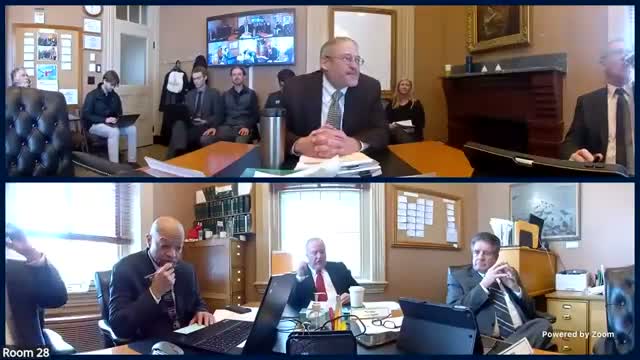
Summary
On testimony about S.323’s section 10, state officials, farmers, renewable-energy advocates and community groups debated whether limits on large solar arrays will protect prime agricultural soil or raise costs and fragment development. No vote was taken; the committee continues to gather input.
Montpelier — A state senate committee heard hours of testimony on S.323’s section 10 on Thursday as lawmakers weighed competing goals: protecting prime agricultural soil, expanding renewable energy and respecting private property rights.
The committee did not take any votes. Chair opened the hearing by saying the panel had made no decisions and was taking testimony "to try to figure out if there's a path forward," and then heard from the Agency of Agriculture, renewable-energy trade groups, farmers and community advocates.
Steve Collier, general counsel for the Agency of Agriculture, Food & Markets, told senators that three principles make the issue difficult: agricultural soil does not regenerate quickly; renewable energy is important to reduce emissions; and private property rights matter. Collier said the current siting framework under 30 V.S.A. § 248 (the Public Utility Commission certificate-of-public-good process) requires mitigation and includes decommissioning conditions tied to certificate approvals. "When you get a certificate of public good from the PUC, there's a required decommission as part of that project," Collier said.
Ben Walsh, climate and energy program director at the Insurance Research Group, told the committee that section 10’s proposed size limits would likely fragment solar development and raise costs. Walsh said Vermont’s Tier 2 Renewable Energy Standard directs roughly 20% of the state’s electricity by 2035 to newly built, in‑state renewables (often sited at up to 5 megawatts). He warned that converting that program to many smaller arrays could push rates higher: citing regional data and Renewable Energy Vermont’s analysis, Walsh said projects built at smaller scale were materially more expensive per megawatt and that, over the life of the systems Vermont needs, the additional costs to ratepayers could reach "hundreds of millions of dollars." He also flagged a bill requirement for site-by-site lifecycle greenhouse-gas assessments as an expensive, unusual new mandate.
Several farmers and residents described local impacts and livelihoods. Farmer Dan Kinney said a 500‑kilowatt array on his property helped pay taxes and keep his farm viable; he described having to take the parcel out of current-use and pay fees but said the land remains in production and that the lease income sustains family members. Jesse McDougall, a fifth‑generation farmer in Shaftesbury who lives near a large proposed project, said large out‑of‑state developers targeted sites near transmission lines and had bulldozed forest and old dairy fields. McDougall urged the committee to preserve tools for towns and to distinguish small farmer-led projects from large corporate developments; he called the bill’s 5‑acre threshold ‘‘precisely the tool we need’’ to make that distinction.
Community and environmental advocates asked the committee to consider how incentives and tax rules shape development. Witnesses noted that utility-scale projects can receive property‑tax and education‑tax treatment that critics say reduces local tax receipts, and that the current uniform capacity tax (a state levy that can be as low as about $4 per kilowatt above 50 kW) can result in a 500‑kilowatt project paying roughly $2,000 annually in lieu of higher local taxes. Advocates also urged that the Public Utility Commission be given clearer authority to evaluate where power and renewable energy credits flow and whether projects serve Vermont interests.
Representatives of renewable‑energy trade groups urged a balanced approach. Adam DeCresse, representing Renewable Energy Vermont, said that while opposition and debate are normal for every project, distributed generation reduces pressure to build larger infrastructure and supports grid resilience. He also cautioned that electricity markets are regional and that how power is contracted and settled is more complex than the simple idea of ‘‘electrons leaving the state.’’
Committee members asked technical questions about decommissioning timelines, how mitigation under the PUC process compares to Act 250, and whether the Agency of Agriculture should be a mandatory participant in all siting proceedings. Agency counsel said the agency already intervenes when prime soils are implicated and that mandatory participation could strain staff capacity.
No formal action was taken. The chair closed the hearing by thanking witnesses and reiterating that the committee was collecting testimony to determine a path forward.
What’s next: The committee will continue to receive input; no vote date was announced.