
Peoria County committee advances final road‑use agreement for proposed wind project
Get AI-powered insights, summaries, and transcripts
Sign Up Free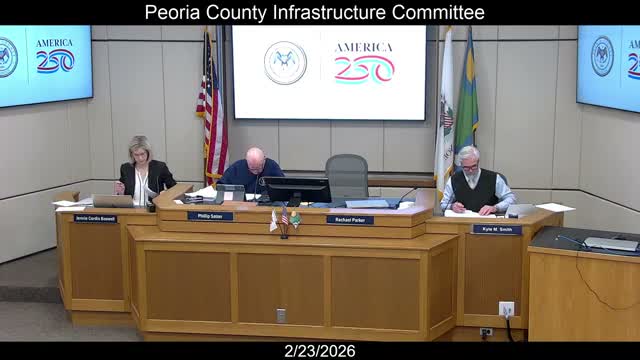
Summary
The infrastructure committee voted to forward a final road‑use agreement for a proposed wind project to the county board after staff described protections including a 150% financial assurance multiplier, a $1.5 million escrow, expedited letter‑of‑credit access and warranty/inspection provisions; townships must finalize parallel agreements before the developer may apply for special use.
Peoria County's infrastructure committee voted to forward a final road‑use agreement for a proposed wind project to the full county board after hearing detailed staff presentations on construction oversight, financial assurances and enforcement provisions.
Andrew Kite, county staff, told the committee the agreement was developed with input from the state's attorney's office, county administration, finance, the county engineer and third‑party engineers. He summarized how the agreement would protect the county: developers must submit preconstruction plans for county review; the county will require financial assurance equal to 150% of the projected repair cost; and an immediately accessible escrow component (described in the packet as $1,500,000) is included so the county can access funds quickly in the event of a claim.
"That projected scope of repairs is then multiplied by 150% and that is the financial assurance amount that has to be provided to the county," Kite said, providing a hypothetical example that a $10,000,000 projected repair scope would require a $15,000,000 assurance plus an escrowed $1,500,000 to be available for quick draws.
Kite also described enforcement mechanics: a letter of credit instrument is included that, when properly called, must make funds available to the county the next business day; fines for violations are possible and disputed fine amounts must be paid into escrow while disputes are resolved. He said the agreement contains no per‑violation cap on fines and also incorporates a warranty period that covers a three‑year subsurface warranty and a one‑year surface warranty after construction.
Committee members pressed staff on process and timing. Staff confirmed the document before the committee is the final proposed road‑use agreement and that approval here would send it to the county board for final action. Townships affected by the project will negotiate separate township agreements; staff said townships may "piggyback" on the county document or negotiate similar terms but must have agreements in place before the developer files a special use petition with the zoning board of appeals.
Other operational provisions discussed included developer reimbursement to the county for third‑party engineering, attorney time and staff time incurred during oversight; inspection authority by county highway staff; and an annual operations maintenance fee during the life of the project (staff cited an example of $3,000 per mile with an inflation escalator).
Several members expressed appreciation for the multi‑year staff effort to craft the agreement and for outside subject matter experts who assisted. After questions, the committee voted to advance the road‑use agreement to the county board.
What happens next: if the county board approves the agreement, staff said developer township agreements must still be finalized and a special use application will be required before construction permits are issued. The committee's action does not itself authorize construction.