
Universities and state agencies warn wildfire and seismic detection systems face funding gap
Get AI-powered insights, summaries, and transcripts
Subscribe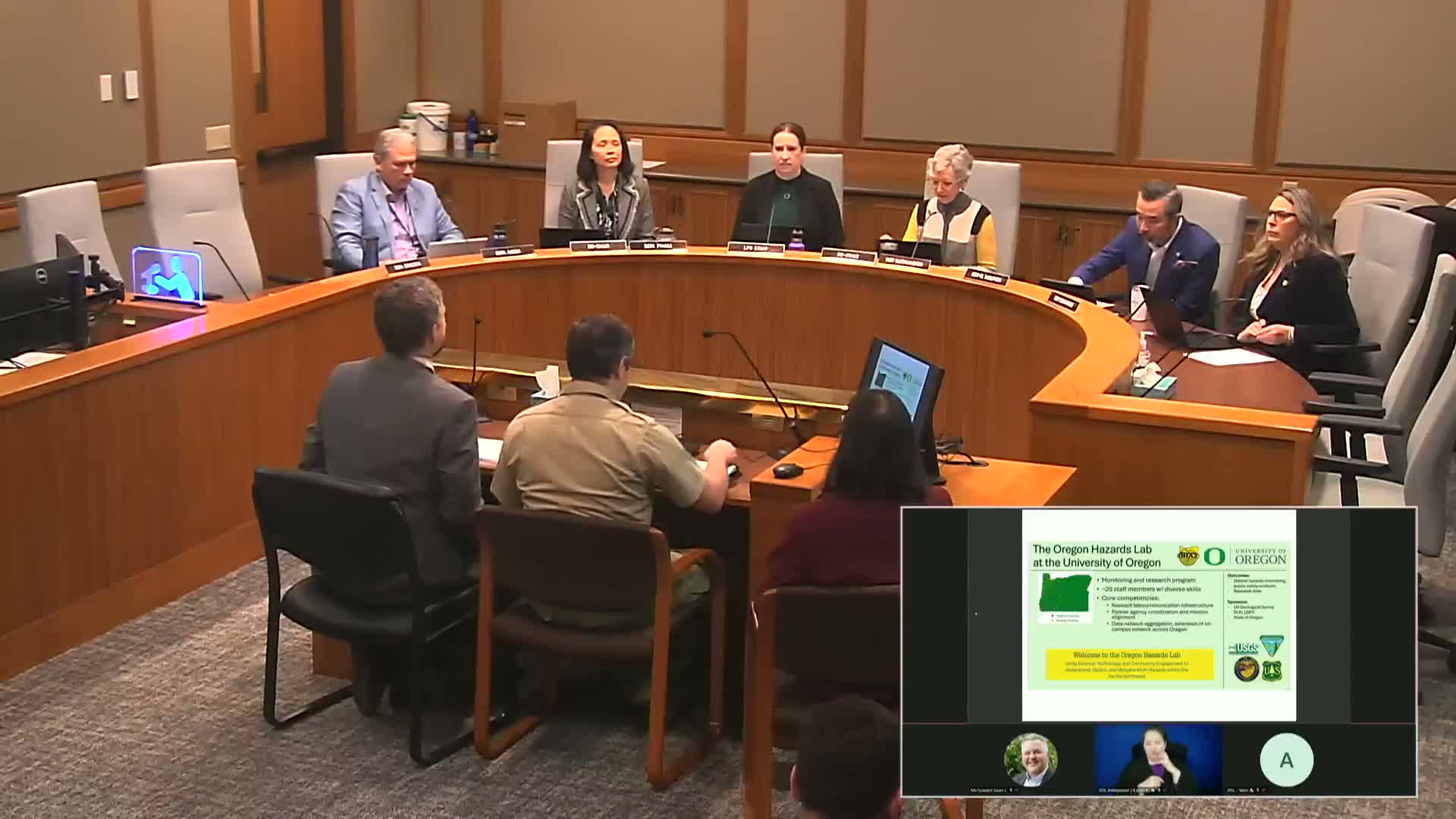
Summary
Oregon Hazards Lab, Department of Forestry and Link Oregon outlined coordinated seismic and wildfire detection systems, described partnerships and technical backhaul options, and warned that funding shortfalls (about $2 million) put many fire cameras at risk ahead of a potentially severe fire season.
University of Oregon's Oregon Hazards Lab, the Oregon Department of Forestry and Link Oregon told the Joint Committee on Information Management and Technology on Feb. 20 that a coordinated statewide hazard-detection and communications system is operating but faces funding and capacity challenges that put sensor and camera coverage at risk.
Leland O'Driscoll, director of the Oregon Hazards Lab, described resilient telecommunications that combine the statewide fiber backbone, the State Radio Project and FirstNet with emergent satellite links to backhaul seismic sensors and wildfire cameras. OHAZ said its program includes about 20 staff and that it aggregates data feeds into state and regional systems such as the Pacific Northwest Seismic Network and ShakeAlert.
OHAZ highlighted a recent success: the Medford School District used ShakeAlert procedures during a large offshore quake in December 2024 and successfully practiced an early-warning drill. But presenters warned that ongoing operations require always-live connections and redundancy, and that without additional funding some cameras may go offline.
Levi Hopkins of the Oregon Department of Forestry said ODF operates 86 detection sites across roughly 16,200,000 acres of responsibility and maintains five detection centers co-located with dispatch centers. He described the MOU with the University of Oregon as a way to unify siloed efforts and create joint funding and operations opportunities.
Jackie Wirz, executive director of Link Oregon, described a 2,500-mile nonprofit fiber backbone that provides high-speed, redundant connections and 24/7 monitoring. Wirz said Link Oregon supports research, education and public-safety backhaul and that planned fiber extensions (including a proposed Bend-to-Reno route to better serve Southeastern Oregon) are on hold because Link Oregon is facing a possible 22% base-budget cut.
In response to committee questions, OHAZ estimated camera operating costs in the tens of thousands of dollars per year (on the order of $25,000 per camera depending on installation). OHAZ said the current network includes roughly 180 cameras, an initial build target is 250 cameras, and full coverage of Oregon's terrain may require 500 or more cameras. OHAZ reported an immediate funding shortfall of about $2,000,000 that jeopardizes camera operations and staff coordination.
Committee members pressed presenters on alternatives when fiber is not available; speakers said radio, microwave, 5G and low Earth orbit satellite options are being evaluated as complements to terrestrial networks. Presenters urged the legislature to consider stable operational funding to preserve state investments and staffing ahead of a potentially severe fire season.
The committee moved on after speakers took questions; presenters requested follow-up on budget options and coordination with natural-resources and budget committees.