
Fargo police report: violent crime down ~10% year-over-year, overdoses surge to 169 in 2025
Get AI-powered insights, summaries, and transcripts
Subscribe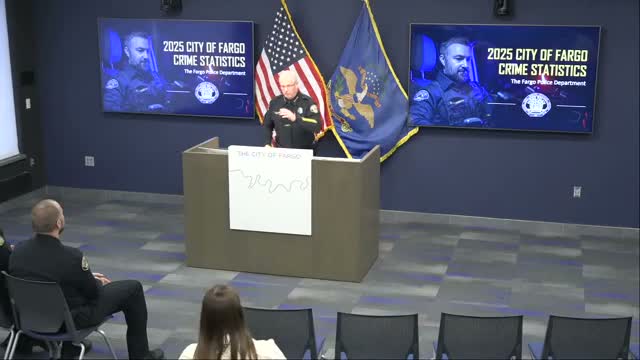
Summary
A Fargo police representative said Class A crimes fell about 10% in 2025 (nearly 17% over two years) while overdoses rose to 169 with 29 fatal; shoplifting and theft of vehicle parts increased and staffing and mental‑health response remain pressing concerns.
At a public briefing, Speaker 1, a Fargo Police Department representative, said the city saw roughly a 10% decrease in Class A (serious) crimes in 2025 compared with 2024 and nearly a 17% decline over two years when combined with 2024 figures. "We had a 10% decrease in class A crimes," Speaker 1 said, stressing the figures are reported to state and FBI systems.
Speaker 1 read several specific changes in counts: 52 fewer (category not specified in the transcript), 83 fewer aggravated assaults, about 298 fewer burglaries, 25 fewer motor-vehicle thefts, 2 fewer murders/non-negligent manslaughters and roughly 24 fewer robberies. The transcript contains a few garbled numeric items; the department’s posted BEAT reports provide the detailed tables for verification on the department website.
Despite the decline in many violent offenses, Speaker 1 highlighted rising property and nonviolent trends. "The two crimes that we see a large increase in across the city are shoplifting," he said, and added theft of motor vehicle parts and accessories also increased. He said beat reports identify retail locations with high shoplifting rates and proposed potential partnerships with stores and stronger prosecutorial follow-through for repeat offenders.
On a separate measure the department has tracked since 2021, the representative said shootings, shooting victims and shots-fired incidents are the lowest recorded since that tracking began: "we have had the fewest amount of shootings, the fewest amount of shooting victims, and the fewest amount of shots fired in the city of Fargo in the 5 years that we've been tracking that data individually."
Speaker 1 described operational tools and resource impacts that helped reduce and detect crime, including a real-time crime center and a traffic safety team. He also described the department’s online desk/officer reporting system, launched in 2022, which he said saved roughly 12,000 officer-hours over about 3.5 years (about 3,000 hours per year, or approximately 1.5 full-time sworn positions) and nearly $700,000 in costs.
Staffing remains a constraint. Speaker 1 said the department’s sworn strength is currently "201" and that the department recently added nine positions in the academy with another academy planned in July; he said the department is below a benchmark of 1.6 sworn officers per 1,000 residents (the transcript cites a historical rate of about 1.4 and a state/federal average of 2 per 1,000).
Public-health concerns featured prominently. Speaker 1 said Fargo recorded 169 overdoses in 2025 — the most in the five years they have tracked this metric — including 29 fatal overdoses (the prior year had 108 overdoses). When asked which substances were most involved he said, "It's gonna be meth and, fentanyl."
Mental-health–related calls also set a record: Speaker 1 reported 4,353 such calls in 2025 and estimated they consumed roughly 3,668 officer-hours, often requiring multiple officers and extended on-scene time. He said more local treatment capacity for people with chronic mental-health conditions is needed and that the Department of Human Services (DHS) is "working on it."
On specific enforcement matters, Speaker 1 described a large chop-shop investigation from the previous year that "didn't result in any criminal charges in the state's attorney's office," adding that department investigators believe significant evidence existed and that the department is "picking it back up." He offered to provide the offense-report number and more details after the briefing.
When asked about an active homicide inquiry, Speaker 1 said the "Azim Holmes" case is "still being actively worked on" and that investigators are awaiting additional evidence and cooperation from outside parties before the next public update.
The briefing closed with Speaker 1 thanking attendees and offering to share offense-report details with interested parties. No formal votes or policy actions were taken at the event.