Maine lawmakers hear widespread opposition to bill that would replace ATV weight cap with classification system
Loading...
Summary
At a Feb. 6 joint committee hearing on LD 276, the sponsor and agencies debated replacing Maine’s 65‑inch/2,000‑pound ATV limit with a multi‑class dimensional system. State agencies and dozens of landowners, clubs and foresters warned the change risks trail damage, enforcement gaps and closures of privately permitted trails.
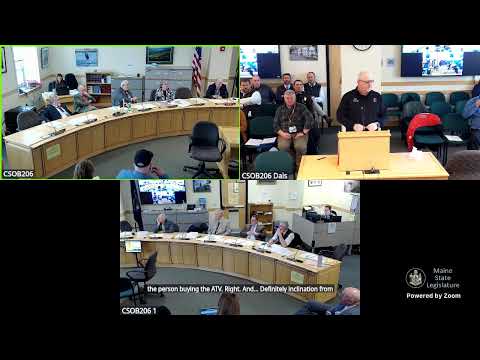
A joint standing committee of the Maine Legislature heard hours of testimony Feb. 6 on LD 276, a bill sponsored by Representative Tiffany Roberts that would modernize ATV classification and registration by phasing weight out as the primary regulatory metric and instead using defined machine classes and dimensional standards.
Roberts, a House sponsor who represents District 149, told the committee the legislation is intended to create a predictable classification and registration process that aligns Maine with multistate standards and reduces recurring ‘reactive’ changes to a single numeric cap. “This bill phases out weight as a primary regulatory mechanism over time and instead modernizes Maine's classification structure,” Roberts said, arguing that weight alone does not account for footprint, width or intended use.
State agencies urged caution. Tim Peabody, deputy commissioner of the Department of Inland Fisheries and Wildlife, testified in opposition, telling lawmakers that Maine’s ATV system “rests on three legs: riders, industry and landowners,” and that actions that erode landowner trust risk rapid closures. Peabody warned that adopting a width‑oriented classification without concurrent enforcement improvements could increase trail damage and friction with landowners and said VIN‑based classification and town‑clerk registration processes pose practical challenges for timely enforcement.
Matthew Foster, supervisor of the state off‑road vehicle program at the Department of Agriculture, Conservation and Forestry, also opposed the bill. DACF provided an economic estimate — based on 2021 data — that ATV recreation supports roughly $750 million for Maine’s outdoor recreation economy and said the department oversees about 6,600 miles of ATV trails, including approximately 4,210 miles on private land. Foster told the committee that, based on landowner feedback, about 30% of privately held trail miles are at “extreme risk” of closure or reduced access if protections are weakened; he also flagged infrastructure costs (bridges estimated at $5,000–$20,000 and gates about $1,500 each) and said enforcement and signage would be costly and complicated under a tiered system.
Landowner and club testimony was strongly negative across the hearing. Amanda Egan, executive director of Maine Woodland Owners, said LD 276 would “replace clear enforceable weight limits with a classification system that has no upper limit on size or weight” and warned the bill appears to retroactively grandfather currently illegal oversized ATVs. Multiple club trailmasters and landowners described volunteer maintenance work and the reliance on private‑land permission for the network; several said large landowners have already threatened to withdraw access if statutory limits are loosened. “This bill violates that trust,” Egan said, urging the committee to recommend the bill not pass.
Representatives of ATV user groups offered mixed views. John Raymond of ATV Maine testified ‘neither for nor against’ and described LD 276 as a longer‑term approach to persistent registration and enforcement problems that accompanied the 2019 task‑force reforms and the 2,000‑pound cap. He said dealer and clerk practices have been inconsistent and estimated several thousand oversized machines are present on the landscape.
Committee members pressed agencies and witnesses on implementation details, including whether the current 65‑inch/2,000‑pound standard is statutory (witnesses confirmed it is), how wardens would measure width or weight on trails (tape measure vs. scales), whether VIN data can reliably classify machines at the point of sale and what counts—if any—exist of summonses or illegal registrations. Agencies said some figures are available but that they will provide more precise counts and technical clarifications at the scheduled work session.
The hearing closed without a committee vote on LD 276. The chair announced a work session will follow in committee proceedings; later in the meeting the committee approved a routine motion to adjourn by voice vote with no members objecting.
What happens next: committee members signaled they want more technical detail on enforcement mechanisms, VIN‑based classification feasibility, exact counts of currently registered oversized machines and clarification of any interactions with other pending bills addressing ATV weight. The committee did not take further action on LD 2054 today and scheduled that matter for a future session.