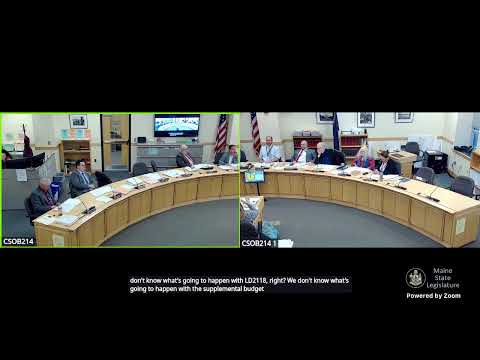
Maine committee hears support for bill clarifying conservation easements to include federally recognized tribes; consideration paused for legal review
Loading...
Summary
Supporters told the Joint Standing Committee on Agriculture, Conservation and Forestry that LD 1054’s amendments would explicitly allow federally recognized tribes to hold conservation easements and clarify cultural-preservation language; the committee tabled the bill to seek legal clarification on surface-water references.
Representative Jim Dill introduced LD 10 54 as amended, saying the measure replaces the original language and makes two focused changes to Maine’s conservation-easement law: it moves historic/architectural/archaeological/cultural preservation language into the definition of a conservation easement and explicitly lists 'federally recognized Indian tribes' among entities permitted to hold easements. He said the edits are intended to clarify rather than change existing law and would provide the Wabanaki Nations additional tools for land stewardship and cultural protection.
Tribal and conservation leaders overwhelmingly supported the amendment in testimony. Molly Bryant, a Penobscot Nation tribal citizen and executive director of the Wabanaki Alliance, told the committee the changes would “expand the definition of conservation easement to include the preservation of history, architectural, archaeological, and cultural aspects” and allow tribes to use the same legal tools as towns and land trusts to care for culturally important sites. Jeff Romano of Maine Coast Heritage Trust and other land-trust representatives said the intended clarification empowers collaborative stewardship between tribes and conservation organizations. Sam Zuckerman of the Permanent Commission on the Status of Racial, Indigenous, and Tribal Populations urged lawmakers to heed tribal requests, calling the measure “a step towards a relationship of co-stewardship.”
Witnesses and advocates framed the bill as a modest statutory clarification that would not lower conservation standards. Sarah Woodbury of Maine Conservation Voters said the change “does not weaken existing conservation standards and it does not reduce environmental protections or open the door to development.” Testimony from economists and policy analysts cited potential broader social and economic benefits of returning stewardship and access to Wabanaki nations.
Committee members asked technical questions about whether the draft carries an emergency preamble and about language in handouts referencing Title 33 and the phrase 'real property includes, without limitation, surface waters.' Representative Mark Cooper asked for clarification whether inclusion of surface waters changes title or ownership rights. Analysts said that the handout in question appeared to reflect an earlier iteration and that the current amendment does not alter existing law on surface waters; nonetheless, members asked for definitive legal advice.
At the end of its work-session deliberations, Senator Black moved to table LD 10 54 to allow staff to get legal clarification regarding surface-water language and other technical questions; the motion to table was adopted unanimously. Committee chairs said the bill will be taken up again later this week with additional legal information available.
Next steps: the committee tabled LD 10 54 pending staff legal review; members expect a follow-up work session later this week to resolve the surface-water question and to reconsider the bill and any emergency preamble.