
Residents urge Doña Ana County to reopen review of Project Jupiter amid health and water concerns
Get AI-powered insights, summaries, and transcripts
Sign Up Free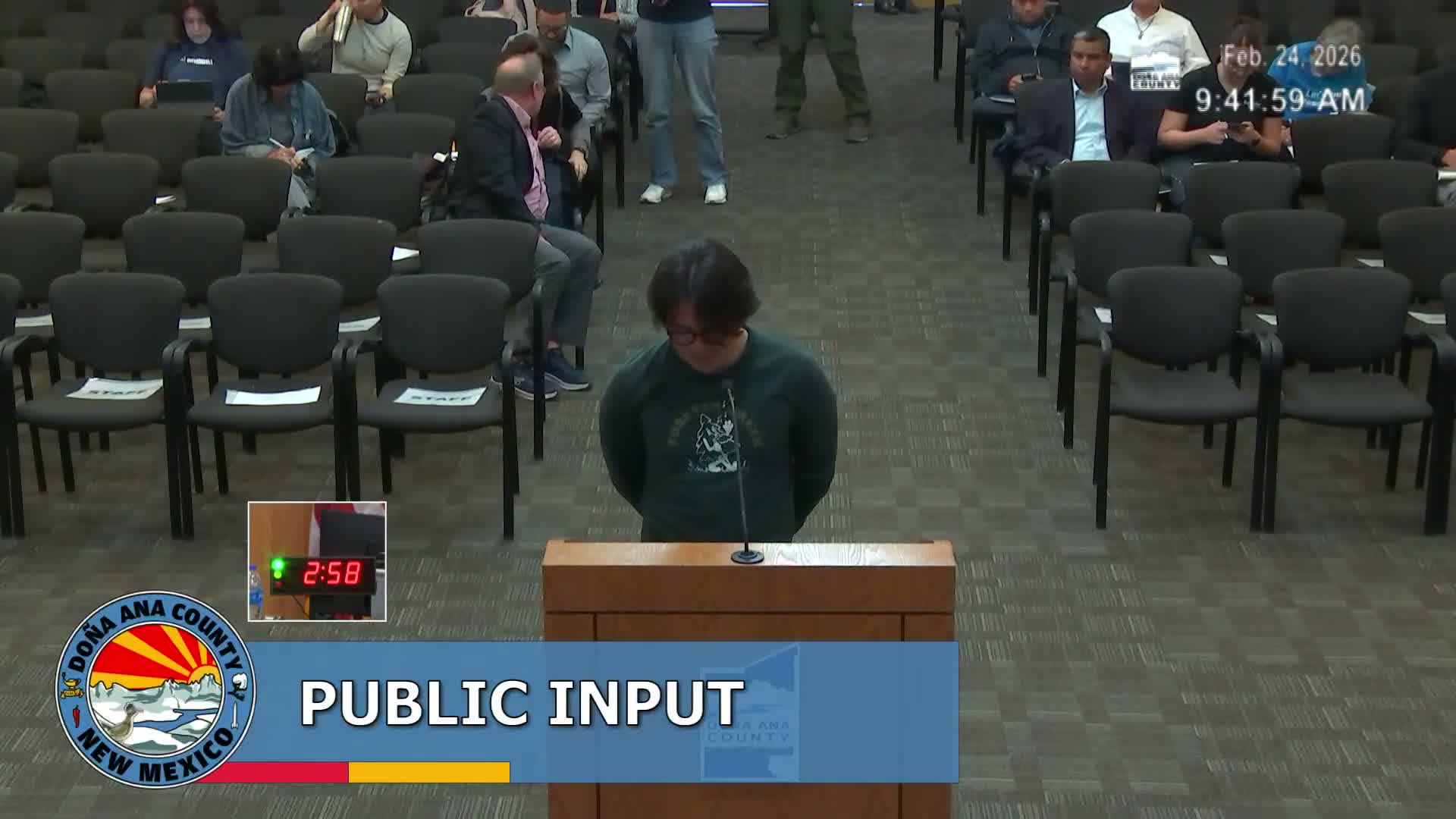
Summary
Multiple public commenters told the commission Project Jupiter was pushed through without adequate oversight and warned of large water use, doubled emissions and harmful local health impacts; the commission listened but took no immediate action during public comment.
A series of public commenters on Feb. 24 urged Doña Ana County commissioners to subject Project Jupiter — a proposed large-scale data center project — to more public oversight, citing environmental, water and health concerns.
Several speakers asked the board to reopen public review or pursue stronger state oversight. "Project Jupiter will only set to increase this with consuming millions of gallons of water, pumping twice as much CO2 as all the New Mexico power plant plants combined," said Aaron Schulte during public comment. Nisha Micanowicz quoted a state senator and accused the project of trying to avoid scrutiny: "A worthy project can withstand oversight. A worthy project can withstand scrutiny," she said, urging the county to demand more transparency.
Patricia Lund directly criticized commissioners who supported taxpayer funding for the project and alleged that benefits would concentrate out of state while harms would fall on local residents; her remarks included sharply worded accusations aimed at board members. Other commenters — including conservation researchers and local residents — raised wildfire risk, emissions of nitrogen oxides and sulfur dioxide, and the project’s split microgrid design that commenters said could be aimed at avoiding emissions rules.
Commissioners listened during the public‑comment period but did not take formal action on Project Jupiter during the meeting. Several commissioners later referenced outreach meetings, and some said they were pursuing follow‑up with project contacts. The transcript records no formal vote, referral, or new staff directive arising directly from the public comments at this session.
What’s next: Commenters called for public hearings, documentation of water and air‑quality impacts, and formal oversight. The commission may receive future agenda items or correspondence (a lawsuit was noted in correspondence) relating to the project or associated state legislation.