Get Full Government Meeting Transcripts, Videos, & Alerts Forever!
Get email alerts on the Criminal Justice topic
No spam. Unsubscribe anytime.
Committee advances bill creating 'grooming' offense to target adults who manipulate minors
Summary
The Committee of the Whole recommended passage of House Bill 9 after adopting a standing committee amendment; the bill creates a new grooming offense that can be charged as a felony in cases where an adult targets a minor, including via electronic communications.
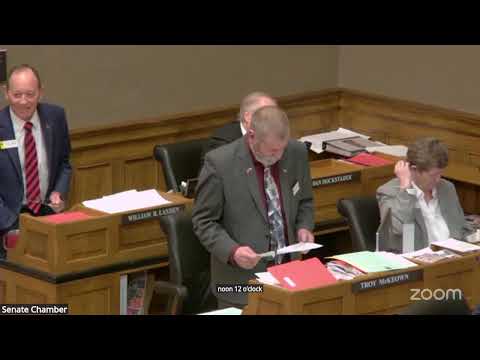
The Senate Committee of the Whole on Feb. 25 recommended that House Bill 9, which creates a new criminal offense of ‘grooming’ when an adult targets a minor, do pass as amended.
Senator Olson, speaking to the Committee, said the bill ‘‘establishes a new crime in Wyoming, and that crime is called grooming of children.’’ He described grooming as ‘‘the process of manipulating a minor to facilitate some type of sexual abuse’’ and said the statute is intended to reach cases that occur even when no physical contact ever takes place. "Grooming means any behavior including sending an electronic communication that seeks to prepare, induce, or persuade a minor to engage in sexual conduct or exploitation, even if no meeting or sexual conduct is ever completed," Olson said while explaining the bill’s definition.
The Committee adopted Standing Committee Amendment No. 1 (which removed an unnecessary list of cross‑references and aligned penalties) and then voted to recommend the bill do pass. Olson also explained the bill’s penalty structure, noting different felony classes and fines tied to imprisonment ranges and that the bill would prevent deferred dispositions for grooming and require convicted persons to be placed on the sex‑offender registry where applicable.
Committee members asked procedural and drafting questions: senators sought clarification that a grooming conviction requires a pattern (not a single, accidental exposure) and that the criminal standard remains proof beyond a reasonable doubt. Olson confirmed both points and emphasized prosecutorial discretion would limit prosecutions that do not meet those elements.
Next steps: Committee recommended HB9 do pass as amended; the bill will return to the Senate calendar for further action.