
Atlanta committee opens public hearing on DeKalb annexation as residents split between legal objections and safety pledges
Get AI-powered insights, summaries, and transcripts
Subscribe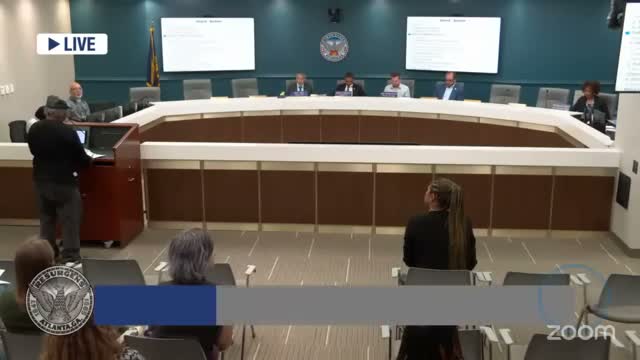
Summary
The Finance Executive Committee opened a public hearing on a proposed annexation of parcels in unincorporated DeKalb County into Atlanta and whether the annexation can extend Atlanta Independent School System boundaries; speakers for and against emphasized legal constraints (citing SB 209) and public-safety or service improvements.
The Atlanta Finance Executive Committee on Feb. 25 opened a public hearing on an ordinance (Item 12601090) that would annex multiple parcels along Sergeant Avenue Southeast, Smith Street Southeast, Ford Street Southeast, Orange Blossom Terrace Southeast, Young Street Southeast, Lehi Drive Southeast, Bouldercrest Drive Southeast and Eastland Road Southeast from unincorporated DeKalb County into the city of Atlanta.
The ordinance, introduced by Councilmember Liliana Bakhtiari and read into the record at the meeting, also states an intention "to extend the boundaries of the Atlanta Independent School System" to include the annexed area and to notify the Georgia Department of Community Affairs. The committee took no final vote on the annexation at the meeting and limited action to opening the public hearing.
During the hearing, GL Jenkins, a member of the public who spoke first, argued the annexation plan for services is legally defective and cannot lawfully promise a transition into the Atlanta Independent School System. Jenkins cited "State bill 209," a Georgia Supreme Court decision referenced in his remarks, and the state code provision read in the meeting, saying those authorities prevent automatic school-boundary changes after annexation unless the change is enacted by a separate local act of the General Assembly or by a formal intergovernmental agreement. "The city cannot transition these students. It cannot sign the school's services," Jenkins said, arguing the petitioners’ 60% threshold cannot "override state bill 209." He also cited that a statute bars boundary changes when the annexed student population is under a 2% threshold of the losing district's enrollment.
Other residents who live in the annexation footprint spoke in favor of joining Atlanta, citing safety and municipal services. Joelle Wasserman said she supports annexation "for all the reasons discussed before," and that her "most priority is safety, and responsiveness of first responders, police, fire, etcetera." John Veneman, who provided his address in the annexation area, described prior experience living in both Atlanta and unincorporated DeKalb County and criticized DeKalb responsiveness to neighborhood problems. Veneman told the committee that annexation would give residents "access to city of Atlanta fire and police" and said the change could move the community from an ISO class 2 fire rating to an ISO class 1, which he said would likely reduce homeowners insurance costs.
Speakers for annexation also referenced neighborhood continuity and local governance. Veneman recounted past local efforts and criticized DeKalb decisions on land swaps and park access, saying he believed those outcomes would have been handled differently under Atlanta governance.
The committee chair, Jason Winston, and other members moved through routine items earlier in the meeting, formally adopting the agenda and approving prior meeting minutes by recorded votes before opening the public hearing. The hearing was opened after a motion and second; the committee did not take a final vote on the annexation ordinance during this session.
No committee action in this meeting resolved the legal questions Jenkins raised about SB 209 and school-boundary authority. Jenkins cited a 2021 enactment he identified as "State bill 209" and a subsequent state supreme court decision; committee members did not provide a legal ruling in response during the public hearing. The ordinance’s language about extending Atlanta Independent School System boundaries remains a point of contention among commenters.
The public hearing remains open for the committee's consideration; no further schedule for final action on the ordinance was provided during the meeting.