
Tennessee Forestry Commission details emergency response, seeks $1 million recurring for state forest upkeep
Get AI-powered insights, summaries, and transcripts
Sign Up Free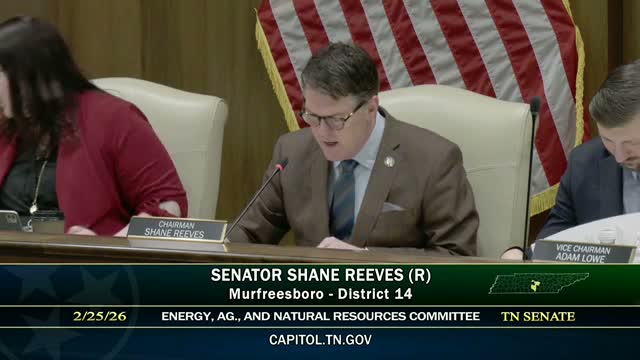
Summary
The Tennessee Division of Forestry told the Senate Energy, Agriculture & Natural Resources Committee it deployed crews for recent ice-storm, hurricane and tornado responses, secured federal relief for landowners, and seeks a $1,000,000 recurring increase for operation and maintenance of state forests.
The Tennessee Division of Forestry presented its annual review to the Senate Energy, Agriculture & Natural Resources Committee, outlining emergency-response work this year and requesting $1,000,000 in recurring operation-and-maintenance funding.
The Forestry Commission’s new chair, John Charles Wilson, told the committee the division responded to an ice storm and Hurricane Helene with large multi-county deployments, clearing more than 10,000 fallen trees and opening about 4,300 miles of roads; crews also assisted in tornado response and remote rescues. Wilson said the agency and partners secured over $38,000,000 in federal relief funds to help farmers and forest landowners recover.
Wilson said Tennessee’s forest cover has roughly doubled since 1914 to about 14,000,000 acres and noted the division’s mission includes wildfire suppression, forest health monitoring, reforestation through the East Tennessee Nursery, and landowner outreach. He described the acquisition of Wolf River State Forest, a 5,488-acre tract with wetlands, miles of streams and registered historical sites, as a major conservation milestone.
A central ask in the presentation was recurring funding: the Forestry Commission has requested a $1,000,000 recurring increase for FY2026 and FY2027 for operation and maintenance of the state forest system. Wilson and commissioners said the money would fund routine maintenance—gravel, gates, signage, cameras, post-hole drills, third-party security oversight where needed—and road and bridge repairs to manage rising visitor use and impacts from ATVs and horseback riders.
Senators pressed on specifics: one asked how much of the state’s forested acreage is privately owned and was told roughly 83 percent is private; another asked about urban-forest recovery in Nashville, and State Forester Heather Slayton described an urban-forestry strike team and a 30,000-foot urban-forest analysis supported by federal funds to inventory hazard trees and guide replanting. Members also questioned invasive-species monitoring and the Division described trap networks and citizen-science reporting for pests such as spongy moth and emerald ash borer.
Wilson and commissioners framed the O&M request as preventive investment: signage and managed access reduce repeated damage from inappropriate use and lower the long-term cost of recovery. The committee heard the presentation and moved on to legislative items; no formal committee action was taken on the funding request during this meeting.
The Division of Forestry materials, including the full annual report, were provided to committee members for follow-up. Further budget action would occur during the budget-review process in the General Assembly.