St. Tammany public works reports 2025 repairs, outlines $20M district capital, expands rapid-response ‘barn’ projects
Loading...
Summary
Public works director Jay Watson told the St. Tammany Parish Council that crews completed dozens of 2025 road, concrete and drainage projects and will work from an approved $20 million 2026 district capital budget while continuing a $3.3 million rapid-response “barn” program for projects under $100,000.
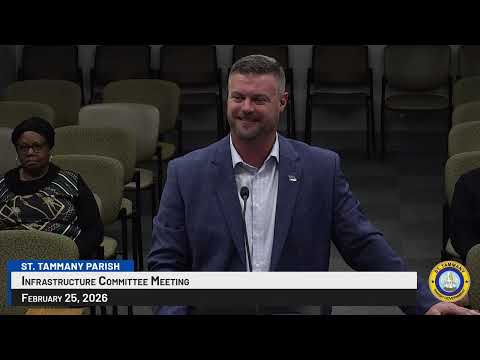
Jay Watson, the director of public works for St. Tammany Parish, told the parish council on Monday that crews completed a range of 2025 roadway, concrete and drainage projects and will work from an approved $20 million district capital budget for 2026.
Watson said the parish maintains "about, 1,600 road miles" and that the 2025 allocation across 14 districts was roughly $11,000,000, with asphalt work accounting for about $5,200,000. He described work completed last year as "your mill and overlay projects, turning radius projects" and said several district packages were finished.
The presentation highlighted the barn program — a fund for work under $100,000 that Watson said allowed staff to respond more quickly to emergent problems than traditional procurement. "This allows us to really be able to handle that, quickly and effectively," Watson said, adding the program let staff attack more than 70 locations parishwide. He said the first full year of barn funding amounted to roughly $3,300,000 and that the department spent most of it in 2025.
Watson explained how barn funding is distributed in his example: "we have $120,000 for roads and $120,000 for drainage in all of the barns," producing an aggregate that, when multiplied across barns, matched the $3.3 million figure he cited. He emphasized the program reduces the need for a multi-month budget process when urgent repairs are needed.
On larger district capital spending, Watson said the council approved $20,000,000 for 2026 after amendments to a proposed $17,000,000 plan. He said the revised allocation included about $12,200,000 for asphalt projects and $1,200,000 for concrete, with drainage and miscellaneous projects making up the remainder.
Council members asked about how projects are categorized and when an issue becomes an engineering project rather than routine public-works work. Watson said staff triage requests and "go look at it and see if it looks like it's gonna be something that public works wants to run with and put together a cost estimate or if it's something more geared towards Daniel and his crew" for engineering involvement. He also confirmed that public-works projects are limited to unincorporated areas and that cities handle work inside city limits.
Watson said the department employs roughly 230 staff with about 13–15 vacancies and that vacancies and equipment-operator turnover are ongoing management issues. "We're not where we want to be, and we're not going to stay where we're at," Watson said, adding the department sees room for incremental improvements but would need to evaluate staffing before asking for additional funding.
The council praised the public works and engineering staff for their responsiveness and urged continued attention to drainage, guardrail repairs and gravel-to-asphalt projects identified for 2026.
The council moved on to other agenda items after public-works questions concluded.