
Tennessee ECD requests $25M for nuclear supply chain, $20M for entertainment incentives in FY27 budget pitch
Get AI-powered insights, summaries, and transcripts
Subscribe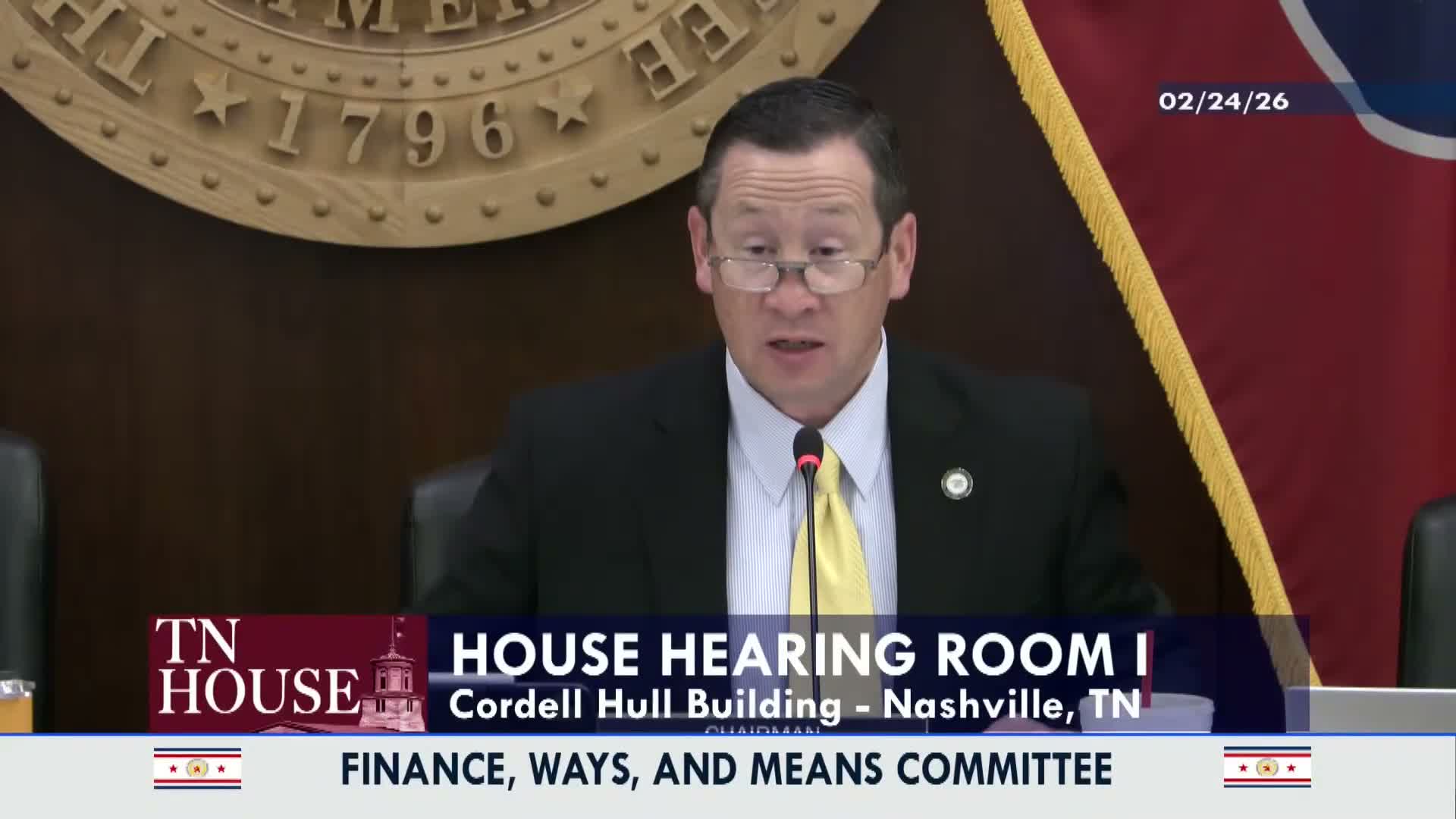
Summary
Commissioner Stuart McWhorter told the House Finance committee on Feb. 24 that the Department of Economic and Community Development's FY27 request includes $25 million for a nuclear supply-chain fund, $20 million for entertainment incentives, $25 million for rural development and $20 million for a quantum infrastructure initiative, with officials stressing federal matches and pipeline demand.
Stuart McWhorter, commissioner of the Tennessee Department of Economic and Community Development, laid out the agency’s fiscal 2027 budget request to the House Finance committee on Feb. 24, asking lawmakers to approve targeted investments his office says will sustain job recruitment and expand new economy sectors.
McWhorter said ECD seeks $25,000,000 nonrecurring for a nuclear supply-chain fund that the department says has already helped attract roughly 3,000 net new jobs and nearly $11 billion in capital investment since the fund’s creation. He described the fund as the principal incentive vehicle for nuclear-related projects and said that an additional $25 million is needed because only about $7 million of the previously authorized incentive pool remains unobligated.
The department also requested $20,000,000 nonrecurring for the Tennessee Entertainment Commission to expand film, television and music production incentives. Bob Raines, executive director of the commission, told the committee that Tennessee has a competitive film workforce and recent capital investment ($200 million reported for 2025 and more projected) and that the commission’s grant structure aims to scale the state’s marketplace rather than match larger programs run by Georgia or Texas.
Other line items included $25,000,000 nonrecurring for the rural development program to support site development and Main Street projects; $2,000,000 (split as $1,000,000 recurring and $1,000,000 nonrecurring) for AgLaunch to expand farmer networks and AgTech commercialization; $1,500,000 nonrecurring for a flight incentive program intended to recruit direct international routes; a request for approximately $538,000 recurring for development districts; $2,500,000 nonrecurring for ETSU’s Eastman Valley Brook iLab biomanufacturing project; and $20,000,000 nonrecurring for a Quantum Infrastructure Initiative intended to leverage Oak Ridge National Lab, Chattanooga EPB and state universities and to unlock federal matching funds.
Members pressed ECD staff on program details and fund accounting. Brooksy Carlton, assistant commissioner for community and rural development, said most carryforward money for rural grants is already obligated as reimbursement grants that can take two to three years to draw down, and that the department typically funds roughly 40–60% of grant applications and provides technical assistance to unsuccessful applicants. McWhorter explained that prior nuclear appropriations have been treated as separate pots—some directed to modular reactor grants, some to supply-chain incentives—and that the department keeps an internal tracking sheet showing obligations and remaining balances.
Representative questions also focused on governance and administrative costs. In response to questions about an administrative carve-out, department staff said the entertainment incentive program can retain a small portion of the appropriation for operating costs (they cited an amount “a little less than $100,000” carved from larger funds for administrative elements), and that existing department staff absorb most program administration rather than hiring positions funded from incentive dollars.
On quantum, McWhorter said the $20 million request is primarily for shared infrastructure and fiber connectivity to link supercomputing assets across the state and is intended to position Tennessee to receive substantial federal matching dollars; he said the state would pause spending if federal match did not materialize.
The presentation closed after members praised successes in nuclear and entertainment recruitment and asked for follow-ups on line-item specifics and pipeline projects. No formal votes were taken during the hearing.