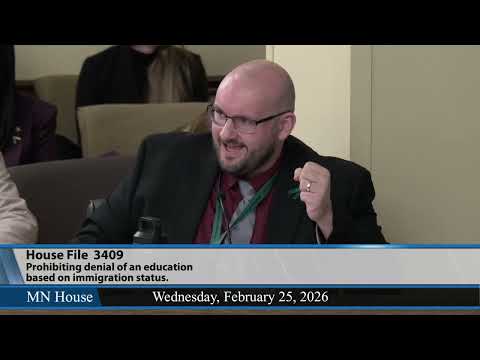
House Education Committee deadlocks on effort to codify federal protections for student access to education
Loading...
Summary
The committee considered House File 3409, a bill intended to affirm schools’ duty to comply with federal law (citing Brown and Plyler v. Doe). A motion to re‑refer the bill to Public Safety failed on a 7–7 roll call and the bill was laid over.
The House Education Policy Committee debated House File 3409 on Feb. 24 and failed on a tie vote to re‑refer the measure for further consideration. The bill’s sponsor had asked the committee to advance the legislation as a statement that public schools must comply with federal law, while opponents said the change was unnecessary because courts and prior state guidance already require compliance.
Supporters framed the bill as a values statement. Representative Gottfried urged members to “codify within statute that every child has a right to a world class education” regardless of immigration status, saying the measure would reaffirm protections amid national attacks on student access to school. Representative Sensory Murrah, the bill’s author, argued the measure was a safeguard against bills elsewhere that would restrict students’ educational access.
Opponents, including Chair Bennett, argued the bill duplicated existing protections. Bennett said recent guidance from the Minnesota attorney general (Feb. 14, 2025) and existing federal case law already affirm school obligations, and described the amendment as “unnecessary,” noting she would “urge members to vote no on the bill.” She also withdrew a DE1 amendment that would have explicitly required schools to comply with federal law.
The chair moved to re‑refer the bill to the Public Safety Finance and Policy Committee and a roll call was held. Recorded votes show a 7–7 split; the motion did not prevail and the bill was laid over. The committee’s action preserves the record of the debate while leaving further action to a later date.
The committee did not adopt new statutory language or send the bill forward; members who support the bill said they will continue to pursue protections, and opponents said the state’s existing combination of federal law, case law, and AG guidance is already sufficient.