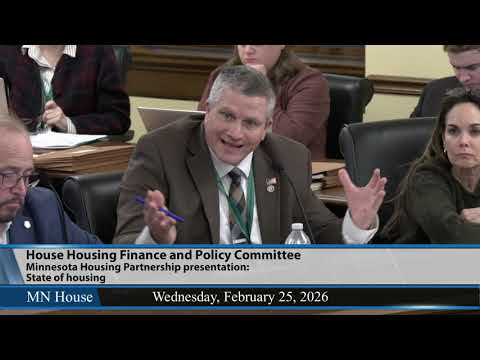
Minnesota Housing Partnership tells committee state is short about 100,000 homes; production and affordability remain concern
Loading...
Summary
Minnesota Housing Partnership told the committee that the state faces a shortage of roughly 100,000 homes, production is below goals (e.g., Met Council targets), building permits and apartment production are trending downward, and affordability burdens particularly affect lowest-income households.
Anne Mavity, executive director of the Minnesota Housing Partnership (MHP), presented the committee with a data-driven overview of housing supply, affordability, and production dynamics in Minnesota.
Mavity summarized three headline facts: Minnesota does not have enough homes for everyone who needs them; many people pay more than they can afford for housing; and the state lacks sufficient resources to fund solutions at scale. She cited the Met Council’s prior 10-year regional goals and said the region met only 44% of its most recent affordable-housing target (producing 16,000 of a 36,000 goal). Mavity said Minnesota is roughly 100,000 homes short and that building permits and projected apartment production are trending downward—meaning fewer units will come online in the next several years.
Mavity highlighted the distributional impact: there are only about 39 rental homes affordable and available for every 100 extremely low-income Minnesota households, and half of Minnesota renters pay more than 30% of income for housing. She emphasized solutions the committee will consider this session—including Yes to Homes legislation and targeted rental assistance—but noted limited public resources constrain how quickly those solutions can be scaled.
Committee members asked about district-level patterns and the role of zoning; MHP staff pointed the committee to district and county profile materials included in the committee packet and noted land-use reforms as one policy lever to encourage more market production where appropriate.
Mavity closed by urging a multi-pronged approach: increase supply of all housing types, expand rental assistance where feasible, and ensure providers and developments are resourced to preserve existing housing.