House committee moves $9 million stopgap for supportive housing as federal HUD funding shifts leave providers at risk
Loading...
Summary
The committee referred HF3425 as amended to Ways and Means after presenters and providers warned that changes to HUD Continuum of Care funding have created a short-term funding cliff for supportive housing; the bill directs $9 million in grant flexibility to sustain providers while federal priorities are resolved.
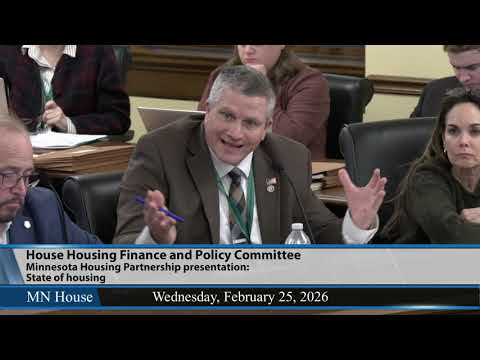
Chair Howard and the Housing Finance and Policy Committee advanced House File 3,425 as amended to the Committee on Ways and Means after testimony that recent U.S. Department of Housing and Urban Development (HUD) policy shifts have put continuity-of-care federal grants at risk.
"Many of these crucial supportive-housing developments cannot withstand even a short term loss of funding," Ann Smedick, director and senior counsel at the Housing Justice Center, told the committee, describing a November 2025 HUD change that rescinded a two-year funding notice and replaced it with a new FY25 application process. She said federal lawsuits and court uncertainty have left projects ‘‘in limbo’’ and facing imminent funding gaps.
Chair Howard framed HF3425 as a targeted, no-new-cost response, saying the bill would redirect existing authority to provide $9 million in grants that could be used to stabilize Continuum of Care (CoC) grantees through the calendar year. "We are facing a potential five-alarm disaster of our supportive housing providers," Howard said, urging members to act to avoid a rise in homelessness if providers close or reduce services.
Service providers and advocates described the risk to households and the financing realities on the ground. Ben Helvik Anderson of Beacon Interfaith Housing Collaborative told the committee Beacon manages dozens of supportive-housing buildings and that thousands of residents’ housing stability depends on CoC funding. Carla Henderson, CEO of Project for Pride in Living, said CoC grants make up an important share of PPL's supportive-services budget (she cited "1,900,000.0 annually or 30%" in her testimony) and urged the committee to grant immediate flexibility to use already-appropriated funds.
Testimony from a lived-experience advocate, Randy Wickham of the Lived Experience Advocacy Network and Minnesota Coalition for the Homeless, underscored the program’s human impact: stable, service-enriched housing he credited with recovery and employment.
Committee discussion acknowledged that the programs are complex and federally intertwined but concluded that the state should provide an interim bridge while the HUD process is clarified. After adoption of technical amendments (DE1 and an A1 amendment adding reporting and fraud safeguards), the committee moved HF3425 as amended to the Committee on Ways and Means by voice vote.
The measure does not appropriate new money on paper; sponsors said it repurposes an existing state program to provide a short-term safety net for CoC-funded projects facing federal uncertainty. The next procedural step is review in Ways and Means.