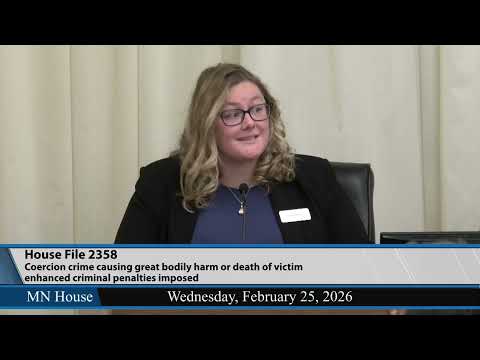
Committee advances bill to increase penalties for sextortion-linked deaths after parents testify
Loading...
Summary
The House Public Safety Committee placed House File 2358 on the general register after testimony from a parent whose son died by suicide following sextortion and support from victim advocates; committee adopted a DE1 amendment to restructure statutory language and clarified the bill focuses on nonconsensual image dissemination leading to death.
ST. PAUL — The House Public Safety Committee voted Feb. 25 to place House File 2358 on the general register after hearing emotional testimony from a Minnesota parent and advocacy groups about sextortion of minors.
Representative Van Binsbergen, the bill’s House sponsor, said the measure was prompted by a constituent whose 16‑year‑old son, Carter, died by suicide after an online sextortion exchange. Van Binsbergen told the panel the bill had been revised in the interim and that a DE1 amendment was before the committee.
A parent who identified herself as Jamie, from Olivia, Minnesota, described discovering messages between her son and a person posing as a teenage girl and said the coercion escalated from requests for images to demands for money. "She absolutely tortured him," Jamie said, recounting that her son first sent $200 and later was pressured for more and then spoke of killing himself. She told members she has since worked on public education and set up a memorial foundation in her son's name.
Ashley Moore, executive director of Citizens Against Sexual Trafficking (CAST), told the committee the bill includes useful accountability provisions and public‑awareness elements. Moore said CAST’s Power Over Predators curriculum teaches online safety in middle and high schools and that students often do not understand legal consequences.
Representative Pinto and others asked why the penalty enhancement was limited to a specific clause of the coercion statute tied to nonconsensual dissemination of private images. Van Binsbergen and nonpartisan staff explained the DE1 restructure clarified causation language and separated great bodily harm and death into distinct clauses; the public‑awareness component originally included by the bill author was removed from the current text to eliminate state cost.
The committee adopted the DE1 amendment by voice vote and, after additional discussion about the "substantial factor" causation language, approved the motion to place House File 2358 as amended on the general register by voice vote. No roll‑call vote was recorded.
The bill now moves to the next legislative steps on the general register; sponsors and advocates indicated an intent to continue work on complementary prevention and awareness efforts.