MnDOT adopts revised cost participation policy with new "ability-to-pay" cap
Loading...
Summary
MnDOT told the House Transportation Committee it adopted an updated cost participation policy and manual that adds an "ability to pay" provision capping a local agency's MnDOT-initiated project contributions at 0.8% of a community's five-year adjusted average net tax capacity; MnDOT estimated the change shifts roughly $20 million in prior local contributions to the state and said the policy takes effect for projects starting in FY2027.
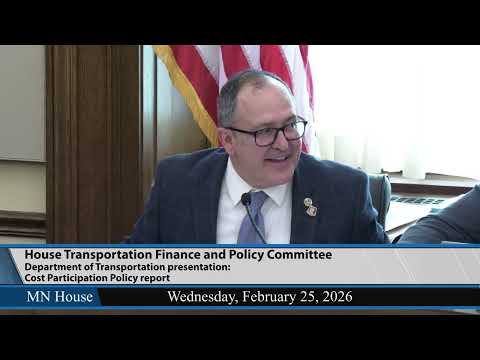
The Minnesota Department of Transportation on Wednesday told the House Transportation Finance and Policy Committee it has adopted a revised cost participation policy and accompanying manual that limits how much local governments must pay on MnDOT-initiated trunk-highway projects.
"Since 2024, MnDOT has been working with our local partners to update the agency's cost participation policy," Philip Schaffner, director of MnDOT's Office of Transportation System Management, told the committee. He said the update was guided by a steering committee that included city, county and township representatives and that the manual incorporates "hundreds of edits" across topics from bridges and drainage to lighting and roundabouts.
The most consequential change, Schaffner said, is an "ability to pay" provision that establishes an "individual project maximum" limiting a local agency's responsibility for trunk-highway-eligible costs on MnDOT-initiated projects to 0.8% of a community's five-year adjusted average net tax capacity. "To give you a sense of the magnitude," he said, "for more than half of the cities in the State of Minnesota, this will limit their costs to less than $10,000." Schaffner told members MnDOT's analysis of FY2024 and FY2025 data suggests the policy will shift roughly $20,000,000 of costs that had been local contributions onto the agency.
Schaffner said the policy and manual were adopted that morning and will apply to projects beginning in state fiscal year 2027, which starts in July. He said MnDOT expects to use carry-forward budget authority and a base increase in state road construction to cover the change in the near term and that training for department and local-agency staff will be provided; MnDOT scheduled a webinar for March 23 to walk through the key changes.
The department also included proposed statutory language in a legislative report that would allow the Trunk Highway Fund to pay for relocation of local-government-owned utilities when MnDOT-initiated construction necessitates a move and the Commissioner determines remaining service life and necessity (a proposed addition to Minnesota Statutes 161.46, subdivision 2). Schaffner said MnDOT and local partners would convene a work group to develop a methodology for calculating remaining service life if the change is enacted.
Committee chairs thanked MnDOT for the work; members were told there would not be time for questions that day but were invited to follow up with the department. The committee did not take formal action on the policy during the hearing; Schaffner said the policy had been adopted within MnDOT and the statutory proposal had been submitted to the Legislature.