Get Full Government Meeting Transcripts, Videos, & Alerts Forever!
Get email alerts on the Transparency Data Access topic
No spam. Unsubscribe anytime.
House committee advances bill to limit report redactions after heated debate over Optum vulnerability study
Summary
After questions from legislators about redactions, data access and Optum's analytics, the House Human Services Finance and Policy Committee voted to refer House File 3378 (language on unredacting portions of the Optum vulnerability report) to the Committee on Judiciary, Finance, and Civil Law.
The House Human Services Finance and Policy Committee advanced House File 3378, a bill concerning disclosure of material in an Optum vulnerability report, after extended questioning of the Department of Human Services and Optum about analytics, redactions and data-security protections.
Representative Norr (first member to speak during minutes approval) and Chair Schumacher led procedural items early in the hearing; committee members then asked DHS and Optum to present before any formal referral on HF3378. After the presentation and a lengthy question-and-answer period the chair renewed a motion to re-refer House File 3378 to the Committee on Judiciary, Finance, and Civil Law and the motion passed by voice vote.
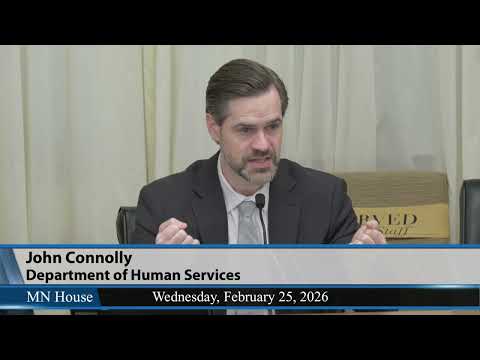
Members expressed two main, repeated concerns. First, many asked why large swaths of the Optum deliverable were redacted and who had access to the unredacted report. Deputy Commissioner John Connolly said the department released a version with redactions to comply with the Minnesota Government Data Practices Act and to avoid publishing proprietary analytics or a "road map" that could be misused. He said unredacted copies had been shared with the commissioner, the governor's office, the Office of the Legislative Auditor and CMS.
Second, several legislators pressed DHS and Optum on analytic accuracy, medical-necessity rules and vendor oversight. Representative Hicks argued analytics did not adequately account for statutory medical-necessity and authorization rules (she cited EIDBI), and Representative Curran questioned the procurement terms, how many contract versions were exchanged and whether Minnesota data could be repurposed commercially. Optum's Jason Bridal said the company produced analytics and indicators and does not make fraud determinations; DHS said the policy teams review flagged claims and that some analytics were adjusted to reflect direct policy rules.
On the question of who may see the full, unredacted report, DHS told the committee it had provided an unredacted copy to the Office of the Legislative Auditor and to CMS, and that the commissioner and governor's office also had access. DHS said it is reviewing which additional redacted items could be shared with legislators consistent with statute, perhaps via individual briefings.
The committee vote to re-refer HF3378 passed by voice vote after the chair renewed the motion. No roll-call tally was recorded in the hearing transcript.
Ending: DHS agreed to continue working with legislators on contract language, data-protection amendments and to provide additional operational metrics about the prepayment review process; HF3378 now moves to the judiciary/finance committee for further consideration.