Minnesota demographer warns state faces prolonged slowdown in workforce growth
Summary
The Minnesota state demographer told the House Workforce, Labor and Economic Development Committee that long-term demographic trends — retiring baby boomers, falling birth cohorts and reduced international migration — are likely to keep workforce growth slow and that migration and training policies will be central to meeting future labor needs.
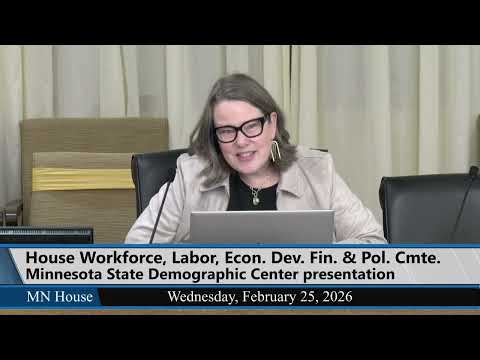
Susan Brower, Minnesota state demographer, told the House Workforce, Labor and Economic Development Committee on Feb. 25 that Minnesota is entering a period of prolonged, structurally driven slow workforce growth.
"I want to talk today about the slowing of labor force growth because it's something that's been happening since at least about 2010," Brower said, summarizing multi‑decade population changes and their implications for employers and workforce policy.
Brower said the state enjoyed rapid labor‑force growth when the baby‑boom generation entered and populated the workforce, but that growth plateaued around 2010 as older boomers reached retirement age. She pointed to falling birth rates since roughly 2007 that will produce smaller cohorts entering working ages in future decades and said regional effects vary: many Greater Minnesota counties have seen declines in prime‑age populations while metro counties saw modest gains.
On migration, Brower described two long‑running patterns: small net losses from domestic migration in many years and historically strong contributions from international migration. She said international migration spiked in the early 2020s (including humanitarian admissions) but that 2025 gains fell by more than half and that current federal policies could further depress international inflows, noting, "the current federal policies around international immigration will impact labor force growth or decline in ways that will be felt by Minnesotans."
Brower also presented workforce composition figures: roughly 24% of workers are people of color, about 48% are women, 12% were born outside the U.S., and roughly a third are parents. She emphasized persistent disparities in educational attainment across racial and ethnic groups and recommended prioritizing skills development and training — especially for essential occupations such as direct‑care health workers, food production and energy — under a slow‑growth scenario.
During questions, legislators raised the potential effects of artificial intelligence on employment, domestic migration and the income profiles of recent arrivals. Brower said AI will have impacts but that current forecasts lack reliable precision on timing and scale. She offered to provide county‑level and disaggregated reports (including an "economic status of Minnesotans" report) to inform policy choices.
The presentation concluded with a pledge to share slides and data with the committee. Brower framed international migration as the most expedient path to population and workforce growth but said it is contingent on federal policy and therefore uncertain.
AI generated
The text on this page is AI generated. Summaries, highlights, analysis, and video transcripts are all produced from the original source material.
AI can make mistakes, so if you spot one, and we will fix it for everyone.
Note: the source content is unaltered by us. Any content source we link to, be it a video, an audio recording, or a document, is presented exactly as its publisher released it. That publisher is usually a government body, sometimes an individual official or another organisation.