Minnesota Realtors tell committee inventory remains tight; analysts estimate ~20,000 owner homes needed to reach balanced market
Loading...
Summary
Minnesota Realtors Association presenters told the House committee that MLS data show a tight statewide market (about 2.2 months supply), slow recovery of first‑time buyers and volatility driven by rates, taxes and insurance; they estimated roughly 19,500–20,000 owner‑occupied homes are needed to reach a 4–5 month balanced market.
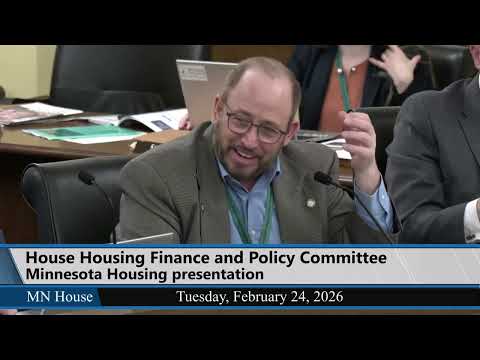
Paul Eager, senior vice president for governmental affairs at the Minnesota Realtors Association, and David Arbitt, who led the data presentation, told the House Housing Finance and Policy Committee that Minnesota’s housing market remains undersupplied and that regional variation matters.
Arbitt said MLS metrics show statewide months of supply near 2.2 months compared with a balanced market target of 4–5 months. “What weve come up with is we need about 19 and a half thousand, about 20,000 homes,” Arbitt said, adding that the need differs by price band and geography.
The presenters walked members through measures including new listings, active listings, pending vs. closed sales, median price trends, and the relationship between mortgage‑rate movement and mortgage applications. Arbitt said inventory and buyer activity have both declined but at similar rates, which has kept the market tight. He also showed that median home‑purchase payments have risen substantially, driven by higher rates, taxes and insurance, and that these payments now consume a larger share of pretax income than in recent history.
Arbitt highlighted that the share of first‑time buyers has fallen and that the typical first‑time buyer age has risen toward 40. He said mortgage‑rate declines would likely spur more applications, but questioned whether supply would be available if demand re‑accelerates.
Committee members asked for additional benchmarking. Representative Nash asked for state comparisons that focus on permitting and regulatory changes that produced faster housing growth elsewhere; Arbitt agreed to provide regional benchmarking. Representative Johnson asked whether cross‑border movement into Wisconsin is affecting local affordability; Arbitt said some counties on the Wisconsin side are captured in Twin Cities metro statistics and that the MLS can examine cross‑border flows.
Arbitt and Eager closed by emphasizing that solutions are local and that a mix of policy levers — tax/regulatory changes, incentives and capital investment — will be needed to increase supply at the price points where demand is greatest. Chair Igo thanked presenters for the analysis.