Minnesota Housing reports 2025 activity: $1.8 billion in programs, 73,000 households served; agency urges focus on preservation and bonds
Loading...
Summary
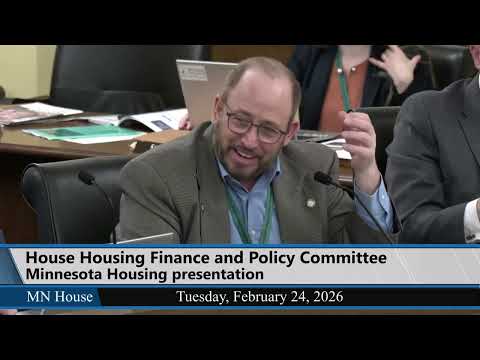
Commissioner Jennifer Ho told the House Housing Finance and Policy Committee that Minnesota Housing’s 2025 program assessment shows nearly 73,000 households served and about $1.8 billion in program resources; she urged continued investment in preservation and housing infrastructure bonds to maintain pipeline momentum.
Commissioner Jennifer Ho of the Minnesota Housing Finance Agency told the House Housing Finance and Policy Committee that the agency’s 2025 program assessment reflects a large, diverse portfolio of housing work spanning homelessness prevention, rental production and homeownership support. “We served nearly 73,000 households,” Ho said, and the agency managed roughly $1.8 billion across its program areas in the reporting year.
Ho told members the agency’s homeownership lending accounts for about 8% of the state’s mortgage originations by number and that nearly half of first‑time buyers served — about 47% — are households of color or from Indigenous communities. The agency reported 3,000 rental units financed in the period (approximately 900 new construction, 1,700 rehabilitation and 295 refinancings) and highlighted that its consolidated RFP awards made in December approved $166,400,000 in state investments across 51 proposals, financing about 1,400 units and leveraging an estimated $550,000,000 in total development costs.
Ho described several direct assistance programs, including the Homework Starts with Home initiative, which she said had $51 million in 2025, served about 14,000 households and provided roughly $3,600 on average per household; she clarified that payments under that program go to vendors or property and utility providers rather than directly to beneficiaries. On geography, Ho said the agency intentionally tracks distribution and that 47% of competitive awards since 2023 have gone to Greater Minnesota.
Committee members asked detailed questions about program delivery. Representative Scrava asked who provides homebuyer education and counseling; Ho said Minnesota Housing contracts with nonprofit and community partners and that a partner list is available on mnhousing.gov. On manufactured‑home communities, Ho said lot infrastructure work (sewer, water, electrical) is funded from different program pots than single‑family home production or repair and therefore is not double‑counted in agency totals.
Members pressed Ho about emergency rental assistance and rising evictions. Vice chair Dunstow said rent deadline timing and an uptick in eviction filings are creating immediate need; Ho said the agency is in active discussions with the governor’s office and Minnesota Management and Budget about possible supplemental relief but cautioned that the family homeless prevention and assistance program historically serves only a fraction of need and that administrators must make difficult prioritization decisions when funds are limited.
Ho also described the consolidated RFP selection process and scoring: the agency combines state and federal funding streams (for example, low‑income housing tax credits, HOME, National Housing Trust Fund, state challenge funds and bond‑financed loans) and typically funds a minority of proposals because demand outstrips available resources.
On timing and project readiness, Ho said multifamily applications typically are released in spring, scored over the summer, and awards are finalized by the agency board in December; projects then still require financing closings and construction timelines that can range from several months to as long as five years depending on project readiness and financing gaps.
Ho urged lawmakers to consider continued capital support: she said the governor’s capital investment proposal includes $50 million for housing infrastructure bonds and $10 million for public housing preservation, while some advocates have sought as much as $200 million in bonds this session. “I am hopeful that housing infrastructure bonds will be in the bonding bill,” she said, noting bonds can help keep the pipeline moving.
The committee did not take formal action on policy during the hearing. Chair Igo thanked the commissioner and her staff for the briefing and moved on to the next presenters.