Get Full Government Meeting Transcripts, Videos, & Alerts Forever!
Get email alerts on the State Grant topic
No spam. Unsubscribe anytime.
Minnesota Office of Higher Education warns of tight margin in state grant program; $60M transfer, rationing used to cover shortfall
Summary
State higher education officials told the House Higher Education Finance and Policy Committee that increased enrollment, FAFSA changes producing more negative SAIs and a projected federal Pell shortfall have pushed Minnesota's State Grant program toward a tight biennial margin; OHE used a $60 million intra‑biennium transfer and issued rationing parameters for FY27.
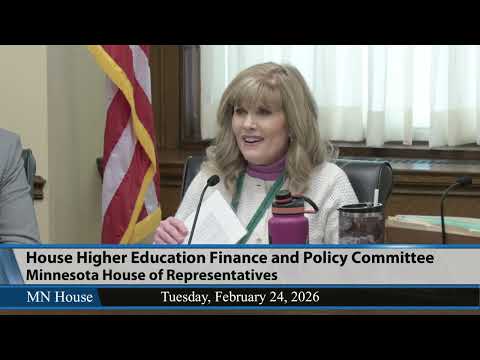
The Minnesota Office of Higher Education told the House Higher Education Finance and Policy Committee that the state’s largest need‑based aid program is facing ongoing pressure from rising demand and federal changes, and that the agency has taken short‑term steps to keep spending within the available appropriation.
"We've seen just over 75,000 students benefit from the program," Megan Flores, director of state financial aid programs at the Minnesota Office of Higher Education, said in testimony describing the Minnesota State Grant. Flores told the committee the program "may not operate on a deficit" and that state law requires the Office of Higher Education (OHE) to publish spending projections each Nov. 1 and Feb. 15.
Nicole Whalen, OHE's state grant research manager, told the committee that two primary factors are driving higher state grant spending: an increase in applicants/enrollment and a higher share of students with very high financial need. "A $100 change in the annual Pell grant maximum does typically have a $5,000,000 per year increase or decrease in state grant spending," Whalen said, adding that the federal Pell program is projected to have "a nearly $12,000,000,000 shortfall" for fiscal 2027 — a development OHE said it is monitoring.
Whalen described steps OHE has taken to keep the program within appropriation: using statutory transfer authority to move funds between fiscal years and issuing rationing parameters that reduce awards across the board for fiscal 2027. "We did transfer approximately $60,000,000 between years in the program," Whalen said; after those adjustments OHE reported a remaining biennial balance of roughly $8,000,000, or less than 2% of available program resources.
Committee members pressed OHE on how the Student Aid Index (SAI) — the federal needs analysis result produced by FAFSA — is affecting demand. Whalen said FAFSA simplification has produced more students at the low end of the SAI spectrum and a much larger number of students with negative SAI values than earlier estimates. "We underestimated, I think, by around 11,000 students" how many would have a negative‑1,500 SAI, she said.
Members also asked about how institutional tuition enters the formula. Flores said the state grant formula recognizes tuition up to the price of the highest‑priced public four‑year institution and that statute capped the recognized 4‑year tuition increases at 2% in each year of the FY26‑27 biennium. Several legislators raised concerns that students attending private institutions receive higher average awards than many public campuses; OHE provided campus‑level averages and said it would supply more detailed breakdowns in writing.
The committee also discussed programs tied to the state grant. OHE explained that North Star Promise, a last‑dollar scholarship program, is influenced by state grant changes. To limit projected North Star spending for the 2026‑27 academic year, OHE set a priority FAFSA filing deadline of June 1, 2026, for North Star applicants and said that deadline could change if statutory changes or additional appropriations occur.
On the question of undocumented or non‑FAFSA applicants, Whalen said roughly 620 recipients used the Minnesota Dream Act/state aid application in FY25, with total state grant dollars for that group reported at about $4,900,000. Flores explained the state application covers a range of applicants ineligible for FAFSA (undocumented students as well as those with pending asylum, TPS, or DACA) and that OHE conducts in‑house verification by collecting tax forms when federal exchanges are not available.
OHE told members it is convening internal working groups to explore alternative need‑based aid models intended to improve long‑term sustainability and predictability, but emphasized such model work would be data‑driven and undertaken cautiously. Legislators asked OHE to return with updates and requested data (campus breakdowns, retention of high‑need cohorts) for future briefings. The committee adjourned after thanking the testifiers.
What happens next: OHE said it will continue to monitor Pell developments and update its projections in the statutorily required November and February reports; the agency also said it will report back to the committee when the governor’s budget recommendations are public or when it has additional modeling recommendations.