
Committee refers bill to ban 'reverse' dragnet warrants to public safety after expert witnesses urge limits
Get AI-powered insights, summaries, and transcripts
Subscribe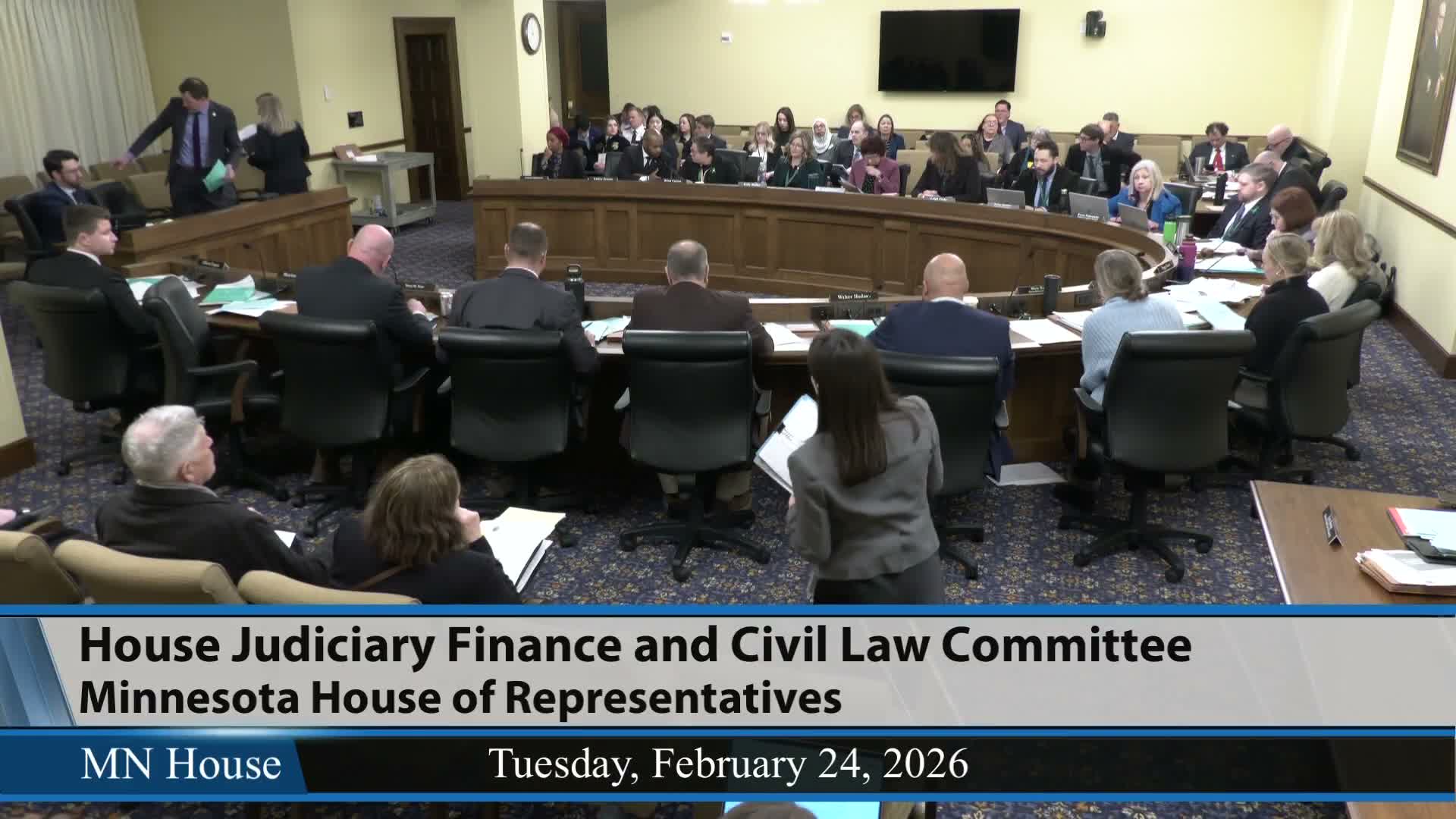
Summary
On Feb. 24 the committee heard testimony supporting HF103, which would bar broad "reverse" geolocation and keyword warrants; witnesses from ACLU and privacy groups cited sharp increases in such warrants and warned of privacy harms while some members sought more tailoring; the bill was re-referred to Public Safety Finance and Policy for further work.
The House Judiciary Finance and Civil Law Committee voted Feb. 24 to re-refer House File 103 to the Public Safety Finance and Policy Committee after hearing testimony on the privacy risks of so‑called reverse or "dragnet" warrants. Supporters called the warrants a modern form of general warrant that sweep large numbers of private citizens’ data into criminal investigations.
Representative Feist, the bill sponsor, said HF103 would "prohibit dragnet reverse warrants in most circumstances," citing concerns about widely cast geolocation and keyword searches of technology companies that can return tens of thousands of people's data. Chad Marlowe, senior policy counsel for the ACLU, told the committee that Google geolocation warrants in Minnesota rose from 22 in 2018 to 207 in 2019 — an increase Marlowe said illustrates the rapid growth of these tools. "Reverse warrants are a troubling 21st-century version of a general warrant," Marlowe said.
Technical witnesses reinforced privacy and accuracy concerns. Chris Whalen, chair of Restore the Fourth Minnesota, cautioned that correlating IP addresses or device headers with account holders produces weak signals and a high number of false leads. Witnesses and members discussed that reverse warrants often produce initial identifiers (phone number, IMSI/IMEI) and that investigators may need follow-up legal process to obtain more identifying information.
Committee members asked detailed procedural questions about what data is provided under such warrants, how multi-step investigative processes work, and whether collected data becomes public. House fiscal and research staff said criminal investigatory data is typically classified as confidential while an investigation is active, but records retention schedules govern eventual destruction and can vary by agency. Members raised concerns about emergency exceptions, geographic scope, retention timelines for "non-hit" data, and the possibility that data could later become public under records rules.
Several members praised Representative Feist for willingness to work with stakeholders. Representative Steer asked for law‑enforcement perspectives; chair Liebling agreed additional conversations were needed. Representative Feist said she welcomed continued refinement and stakeholder collaboration. At the end of the hearing the committee adopted a voice vote to refer HF103 to the Public Safety Finance and Policy Committee for further drafting and review.
What happens next: HF103 will go to the Public Safety Finance and Policy Committee, where authors and stakeholders are expected to continue negotiations on emergency-use exceptions, data retention and deletion rules, and narrow-tailoring to preserve legitimate investigative needs while limiting mass surveillance.