Get Full Government Meeting Transcripts, Videos, & Alerts Forever!
Get email alerts on the Constitutional Remedies topic
No spam. Unsubscribe anytime.
Minn. committee hears civil-rights testimony and debates bill to allow state suits for constitutional violations; motion to advance fails
Summary
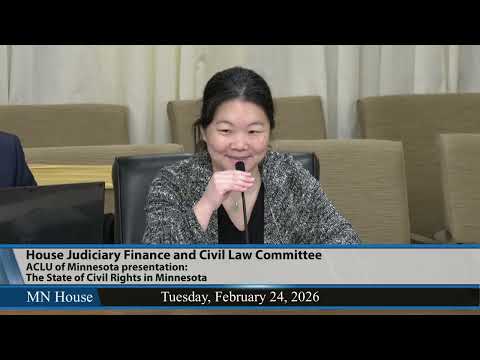
On Feb. 24 the House Judiciary Finance and Civil Law Committee heard testimony from immigrant-rights and civil liberties groups about alleged constitutional violations tied to federal enforcement and debated HF3477, which would create a state cause of action for constitutional harms; committee failed to advance the bill after amendments and a roll call.
The Minnesota House Judiciary Finance and Civil Law Committee heard urgent testimony Feb. 24 about allegations of widespread constitutional violations tied to federal immigration enforcement and then debated a bill that would allow Minnesotans to sue government actors for constitutional harms. The measure, House File 3477, did not advance out of committee after members adopted one amendment, rejected two others, and failed a re-referral motion by recorded vote.
Advocates told the committee they have seen rapid, opaque enforcement activity in Minnesota since Operation Metro Surge began in December 2025. "People have been and are effectively disappearing," said Julia Decker, policy director for the Immigrant Law Center of Minnesota, describing cases in which family members and lawyers could not find detainees because an official locator was not updated. John Bealer, policy counsel for the American Civil Liberties Union of Minnesota, said the ACLU has received "over 700 reports of constitutional violations" and that habeas petitions since December exceed 1,000 compared with 73 in the prior 12 months.
The bill’s author, Representative Long, described HF3477 as a state counterpart to the federal-era remedy commonly cited as 42 U.S.C. §1983: "When a citizen's constitutional rights have been violated there should be a remedy," Long said, adding the proposal would extend a civil remedy to violations by any government actor. Expert witnesses told the committee the concept — sometimes called a "converse 1983" — restores a historic state role in providing remedies and, if properly targeted at constitutional violations, can be designed to avoid Supremacy Clause conflicts.
Committee members debated scope and constitutional risk through several amendments. Representative Duran offered amendment A1 to remove a subdivision that required intergovernmental-agreement language; Representative Long accepted the change and the committee adopted A1 by voice vote. Chair Scott offered amendment A2 to limit the bill to a six-year look-back; proponents said a six-year window would mirror tort statutes of limitation, but Representative Long and others opposed limiting retroactivity in light of recent events, and A2 failed. Representative Hudson offered A3 to require state agencies to absorb any litigation costs; members sought a fiscal note and debated potential budget impacts; A3 failed.
Concern about federal preemption and existing federal remedies surfaced repeatedly. Representative Hudson argued that federal statutory frameworks such as the Federal Tort Claims Act and the Westfall Act constrain state efforts to impose liability on federal officers. Supporters countered that FTCA and judge-made doctrines like Bivens leave gaps for constitutional remedies and that HF3477 focuses only on constitutional claims rather than statutory torts.
After debate the committee took a recorded roll call on a motion to re-refer HF3477, as amended, to the State and Local Government Committee. The clerk recorded seven ayes and six nays with one member excused; the chair announced that "without a majority, the motion does not prevail," and HF3477 did not move out of committee.
Representative Long said the bill was intended to give Minnesotans a legal path to redress constitutional harms and emphasized he had made bipartisan gestures during drafting. Opponents flagged constitutional challenges, potential cost to taxpayers from litigation and defense, and possible disruption of federal-state law enforcement cooperation if federal agencies refuse to enter agreements construed as subjecting them to state litigation.
The committee did not take further action on HF3477 and proceeded to the next agenda item. The hearing included extensive legal testimony, public comment from a disability-rights speaker, and multiple members’ requests for additional stakeholder input, fiscal analysis, and drafting clarifications.
What happens next: HF3477 may be revised and returned to committee or refiled in a future session; supporters said they are willing to negotiate substantive fixes and to seek further review by state and local government stakeholders.