Get AI Briefings, Transcripts & Alerts on Local & National Government Meetings — Forever.
House committee deadlocks on Office of Inspector General bill after contentious amendment votes
Loading...
Summary
The State Government Finance and Policy Committee debated Senate File 8 56 (an Office of Inspector General bill) and a large "delete-everything" amendment plus multiple follow-up amendments; repeated 7–7 roll-call ties meant most amendments failed and the bill did not advance out of committee.
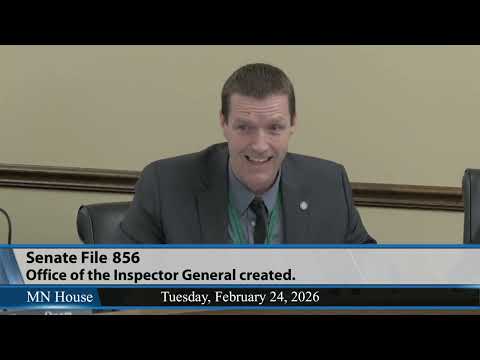
The State Government Finance and Policy Committee on Feb. 24 considered Senate File 856, a proposal to establish a centralized Office of the Inspector General (OIG) to combat fraud across state programs, but the measure stalled after a series of tied roll-call votes.
Representative Jason (Norris) (author) opened by saying his "DE" (delete-everything) amendment preserved "90% of the Senate bill" while fixing constitutional questions and strengthening prevention as well as investigation. He told the committee the amendment would fully fund the office, keep investigative powers such as subpoenas and retain agency subject-matter inspectors, while using a central OIG to oversee best practices across state government. "We need this office to be able to get down to business on day 1," Norris said, urging adequate start-up funding and steps to preserve independence.
Chair Nash prefaced the discussion by noting documents in member packets that raised questions about the provenance of the DE. Nash said some materials suggested the governor's office had sought a different approach than the Senate bill and stressed the committee's obligation to be accurate about how amendments were developed.
Representative Davis pressed the author on funding, asking for specifics where the Senate fiscal note and Senate appropriations diverged; Davis also characterized an allegation that "at least $9,000,000,000" in Medicaid fraud had occurred since 2018 as a justification for strong anti-fraud measures. Norris responded that the Senate fiscal note estimated a multi‑million-dollar biennial cost (he referenced an estimate "around $12,000,000") and explained the constitutional constraint that executive-branch appointments must rest with the governor. Norris said he sought independence through statutory language and multiple safeguards, including a bipartisan Legislative Inspector General Advisory Commission to recommend candidates and a three-fifths confirmation and removal threshold.
Committee members debated multiple author-proposed amendments numbered A1 through A9. Several amendments were positioned to protect independence or to clarify the OIG's duties. Key outcomes:
- The DE amendment was brought to a roll call and resulted in a 7–7 tie; the amendment was not adopted. - A1 (constitutional/appointment language), A2 ("except as provided by law" clarification), A4, A5, A7, A8 and A9 each failed on 7–7 roll-call ties. - A3 (a one-year update to statutory start dates) passed on a 14–0 vote. - A6 (directing the OIG to facilitate information-sharing and coordination between agencies) passed by 13 ayes to 1 nay and was adopted.
Drew Evans, superintendent at the Bureau of Criminal Apprehension (BCA), testified that a consolidated financial-crimes unit already exists at the BCA and said criminal investigators and civil regulatory processes should be clearly separated and coordinated. "Running a police agency is incredibly complex," Evans said; he described an established BCA financial-crimes section and urged statutory clarity on how criminal referrals and arrests would be handled if an OIG contained an enforcement arm.
Representative Anderson, who worked with the Senate author on the underlying bill, urged continued bicameral and bipartisan meetings to resolve remaining technical issues and data-practice questions. Jody McCarthy, a citizen testifier, urged lawmakers to first strengthen existing offices such as Management and Budget before creating a new enforcement-focused agency.
After closing remarks, Chair Nash moved to refer the amended bill to the Judiciary Committee. The clerk's roll call again produced a 7–7 tie, so the bill was not passed out of the State Government Finance and Policy Committee on Feb. 24. Chair Nash and members on both sides said they expect continued work in caucus and working groups to address constitutionality, funding, and stakeholder concerns before the bill is brought again.
Next steps: sponsors said they will continue four‑party (bicameral, bipartisan) negotiations and technical fixes; committee staff and the bill author were urged to coordinate with the legislative auditor, judicial staff and stakeholders before the bill returns to committee.