Get AI Briefings, Transcripts & Alerts on Local & National Government Meetings — Forever.
Counties tell committee HR 1 will overwhelm local eligibility systems; urge IT modernization and short-term "bridging" support
Loading...
Summary
County officials warned the committee that HR 1's verification, renewal and reporting rules will sharply increase county workload, produce manual "workarounds" that raise error risk, and require immediate bridging supports plus long-term system modernization to avoid fiscal penalties and service disruptions.
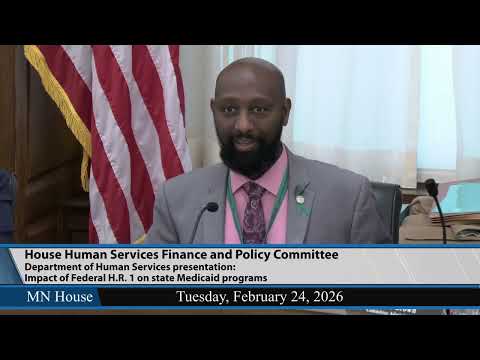
County leaders told the House Human Services Finance and Policy Committee that local governments are on the front line of eligibility determinations and are already constrained by outdated systems and thin staffing.
"Workarounds equal errors because we're introducing the human element in that process," said Angela Youngerberg, a consultant with the Association of Minnesota Counties and MACSA, summarizing a consistent county message: policy changes that are not matched by system automation will force counties into manual fixes that raise error risk and costs.
Counties estimated about 200,000 cases in the adult expansion group will require more frequent redeterminations under HR 1, creating roughly 200,000 additional "touches" per year. County officials gave concrete workload examples: METS, the eligibility system used to determine Medicaid status, still relies on decades-old interfaces in some places; a single case change (a birth on an open case) can require closing and reentering the record, a task the county said can take 45 minutes to two hours per case.
Scott County's director told the committee that, under current assumptions, the county would need two to three additional eligibility staff to handle new renewals and verification work; counties projected statewide administrative costs could run into the tens of millions without state support, and the county-side share of penalty exposure (accuracy-driven cost-share) could be substantial.
County witnesses backed DHSplans to use external vendors for community engagement and verification assistance and urged a combined approach of short-term bridging supports (access to employment and asset verification tools, standardized policy consolidation aids) and a long-term modernization plan to create an integrated eligibility platform.
County leaders also recommended forming targeted work groups involving the Legislature, DHS and county representatives to resolve procurement, privacy and prioritization questions and to accelerate implementation where possible.
The committee closed the hearing without voting on any conforming legislation; members and county officials agreed to continue collaboration on system fixes, vendor use and staffing strategies.