
DHS: Federal HR 1 will narrow Medicaid coverage and add major administrative burdens, agency warns
Get AI-powered insights, summaries, and transcripts
Sign Up Free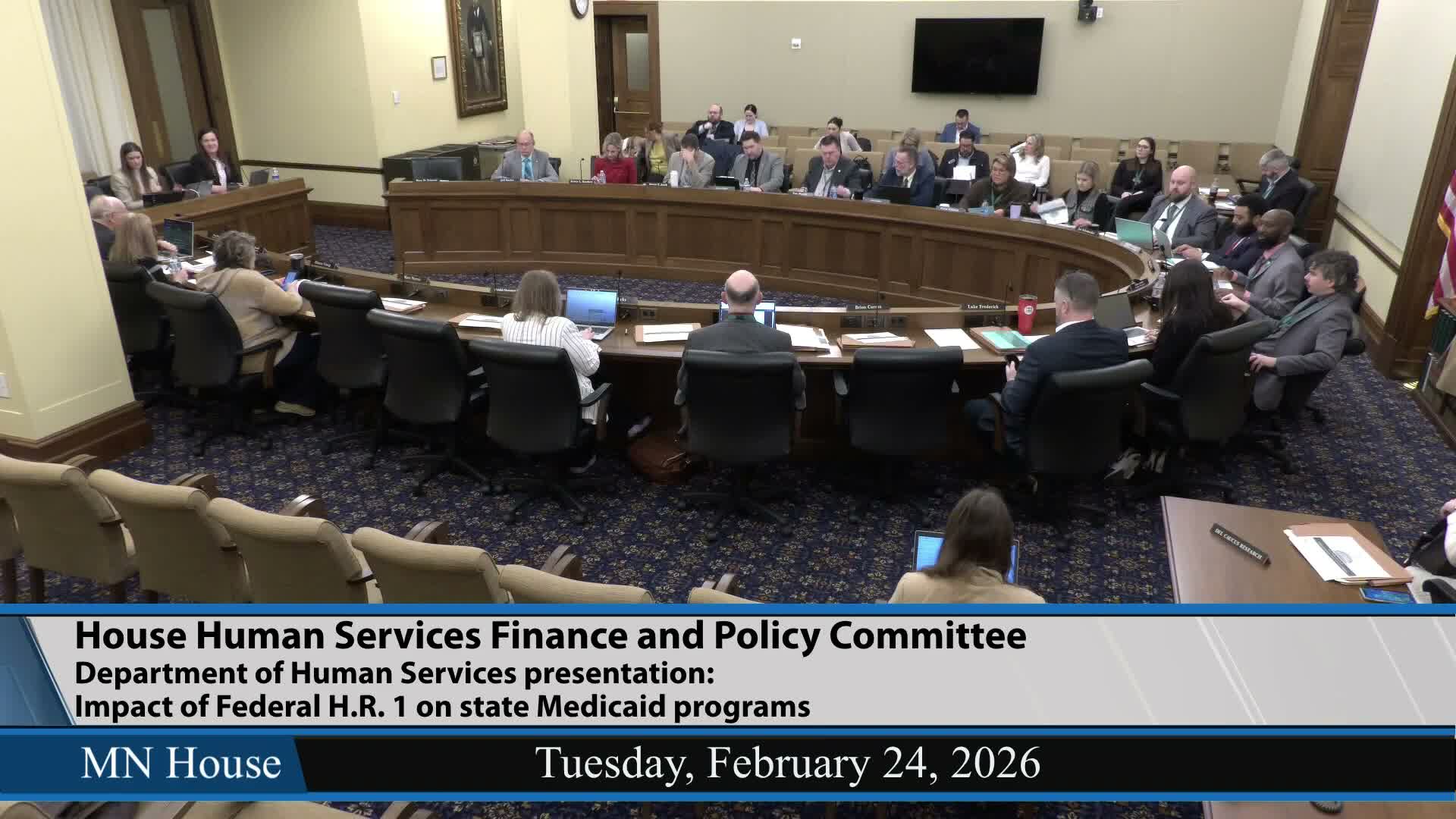
Summary
The Minnesota Department of Human Services told the House Human Services Finance and Policy Committee that HR 1a sweeping federal Medicaid changescould reduce coverage, raise uncompensated care, and require substantial IT and staffing investments to meet tight federal deadlines beginning in late 2026 and early 2027.
The Department of Human Services told legislators that HR 1, a federal package enacted in July 2025, will significantly alter how Minnesota administers Medicaid and related programs and could result in coverage losses for many enrollees.
"These changes will result in simply a loss of health care coverage for people," DHS budget director Elise Bailey said, summarizing the agency's review. DHS staff said the state now serves about 1.2 million people on Medicaid and projects roughly $24 billion in Medicaid spending in fiscal 2026, with about 57% of that funded by federal dollars.
Bailey and her legislative budget colleague described multiple provisions that will hit the adult expansion population (ages 21—64) hardest. That group in Minnesota accounts for roughly 221,000 people and currently receives a 90% federal match. HR 1, the department said, adds work- or community-engagement reporting that would require most adults without dependent children to document about 80 hours of qualifying activity per month unless they qualify for specific exemptions.
DHS emphasized how tightly timed implementation is. The department said states must put the work-reporting regime in place by Jan. 1, 2027, and that the agency has only received preliminary CMS guidance for several key provisions. Bailey said formal guidance, rulemaking and state-law changes will be necessary for full compliance and that the department is mapping system work that began in December 2025 to meet federal deadlines.
The agency also laid out other changes that would add administrative and fiscal strain: six-month renewals for the expansion group (instead of Minnesota's current annual renewals), reduced retroactive coverage for the adult expansion population, the possibility of reinstated cost-sharing for expansion enrollees, and narrowed Medicaid eligibility for many lawful noncitizen statuses beginning in October 2026.
On error rates, DHS officials warned that HR 1 limits CMSauthority to waive penalties when a state exceeds the statutory payment error threshold. "Any increase over 3% is a lot of money," Bailey told the committee, noting Minnesota's recent PAM (payment error measurement) was reported at 2.1% compared with a national average near 6.1%.
DHS described a multi-pronged implementation plan that focuses on maintaining eligible coverage, minimizing burdens on state and local workers, and upholding fiscal responsibility. Among steps: stakeholder work groups with counties, targeted outreach to enrollees, toolkits for partners, call-center scripts and consideration of external vendors to handle outreach and parts of verification work.
The agency urged the Legislature to consider conforming statutory changes and appropriations to fund significant IT and staffing work. Without those changes and resources, DHS warned, Minnesota risks increased uncompensated care for providers and potential federal penalties under HR 1.
The committee did not take action on any bills during the hearing; DHS said it will return with proposed statutory language and more detailed cost estimates as work continues.