
Senate committee divided on electronic-will bill after lengthy testimony; bill fails to clear committee
Get AI-powered insights, summaries, and transcripts
Subscribe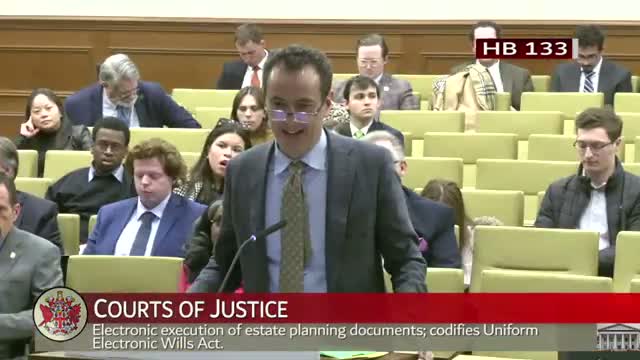
Summary
House Bill 133 would authorize remote execution of wills and advance directives via e‑notary and recorded video with remote witnesses. Supporters said e-wills improve access; opponents and several senators raised concerns about duress, privacy, disinterested witnesses and AI/deep‑fraud risks. The committee recorded a roll call that left the measure short of passing out of committee.
Delegate Simon presented House Bill 133 to allow Virginians to execute wills and advance directives electronically using e‑notary and remote witnesses; e‑notaries would retain a recording of the transaction for a defined period.
Proponents argued the change would improve access to estate planning for underserved and rural communities. Will Harnish of MetLife and representatives from Trust & Will and consumer groups said the approach in other jurisdictions has increased access to estate planning.
Opponents and several senators urged caution. Senator Obenshain and others raised specific concerns about privacy safeguards, encryption standards, the risk of undue influence and duress in remote settings, whether witnesses must be disinterested, methods for revocation and the possibility of AI-assisted fraud. Thomas Galanos, a law professor and Uniform Law Commissioner, said the uniform act permits revocation by act but that translating revocation rules to an e context requires careful drafting. Multiple committee members requested clarifying amendments; committee roll-call results recorded the motion to report with 6 yeas, 8 nays and 1 abstention, leaving the bill without the committee's affirmative report to the floor at that moment.