Minnesota mayors and business owners tell Senate panel Operation Metro Surge hurt small and immigrant-owned businesses; lawmakers consider relief
Loading...
Summary
Mayors, business owners and statewide groups told the Senate Committee on Jobs and Economic Development on Feb. 25 that federal immigration enforcement called "Operation Metro Surge" triggered steep revenue drops, staffing shortages and project cancellations across Minnesota and urged lawmakers to craft emergency relief for affected small businesses.
St. Paul and Minneapolis mayors, business owners and statewide economic organizations told the Minnesota Senate Committee on Jobs and Economic Development on Feb. 25 that federal immigration enforcement operations have produced acute economic damage to small, immigrant‑owned and rural businesses — and urged the legislature to pass emergency relief.
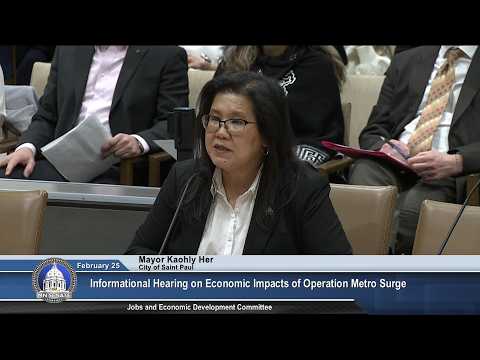
"Hundreds of businesses were closed off and… many more were limited in hours due to a lack of their staff feeling safe enough to come in," Kalee Hur, identified in the record as mayor of Saint Paul, told the committee, saying many of the city’s Mercado and immigrant‑owned restaurants reported sales down "60 to 70%" and that the city had opened a survey to quantify lost revenues.
Why it matters: Committee members heard consistent testimony that the economic effects spread beyond the Twin Cities. Jacob Frey, mayor of Minneapolis, presented a city estimate of roughly $203,000,000 in economic impact, including $47,000,000 in lost wages and an immediate $6,000,000 in municipal overtime costs. Multiple business owners and community lenders described businesses already facing eviction, exhausted cash reserves and canceled expansion projects.
A range of witnesses gave concrete examples. Daniel Del Prado of DDP Restaurant Group said some restaurants saw sales fall "50%" and, in some community cases, "90%," forcing owners to take high‑interest loans and delay vendor payments. Ricardo Hernandez Espinosa, owner of La Michoacan, said his group paused a planned $400,000 project and that his operations collect about $500,000 in state sales tax annually and run a payroll of about $2,000,000 a year.
Statewide and rural impacts: Lauren Bennett McGinty, executive director of Explore Minnesota, shared survey results showing 42% of tourism businesses reporting decreased visitor volume in a winter 2026 survey, and she said cancellations and reduced bookings were already affecting hotels and events. Scott Marquardt of the Southwest Initiative Foundation and Amanda Quam of West Central Initiative said immigrant‑owned businesses in Greater Minnesota were reporting 40–60% or greater revenue losses and that closures and workforce disruptions were straining main‑street economies.
Community finance and relief requests: Lille Blois of the Latino Economic Development Center said the organization reviewed 385 grant applications representing 2,268 employees; more than 65% of applicants reported revenue losses greater than 50%, and 137 businesses temporarily closed. Witnesses urged a mix of targeted emergency grants, loan guarantees and changes to eligibility so growing businesses can qualify for relief.
Committee response and next steps: Chair Champion said staff are drafting legislation and solicited input from members and stakeholders; she said a draft could be available within a week. Senators on both sides emphasized a shared interest in supporting affected businesses while distinguishing this committee’s work on economic relief from other investigations or fraud‑related work in the Legislature.
The committee adjourned after scheduling two upcoming briefings: March 2 with University of Minnesota data scientists (AI ecosystem) and March 4 with the Minnesota Department of Employment and Economic Development (DEED) for additional data and options.
Sources and attribution: The article draws solely on testimony and materials presented to the Senate Committee on Jobs and Economic Development on Feb. 25, 2026, including statements by Kalee Hur (mayor of Saint Paul), Jacob Frey (mayor of Minneapolis), Lauren Bennett McGinty (Explore Minnesota), Scott Marquardt (Southwest Initiative Foundation), Amanda Quam (West Central Initiative), Daniel Del Prado (DDP Restaurant Group), Ricardo Hernandez Espinosa (La Michoacan) and Lille Blois (Latino Economic Development Center).