
PUC officials tell Senate committee they’ve reduced bills but warn interim rate hikes hurt customers
Get AI-powered insights, summaries, and transcripts
Subscribe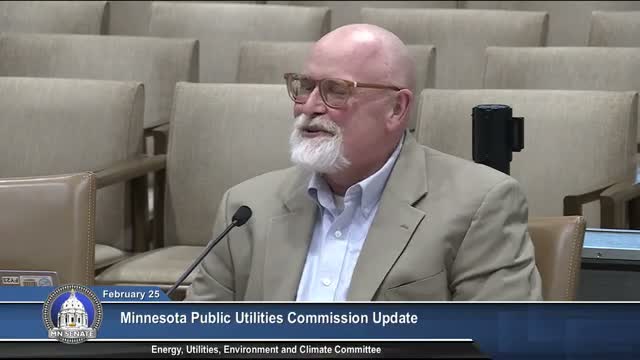
Summary
Public Utilities Commission testimony highlighted recent PUC decisions that reduced customer costs, expanded consumer assistance and set interconnection support — and raised concern that Minnesota’s interim-rate statute can produce sizable short-term bill increases before final rate review.
The Minnesota Public Utilities Commission told the Senate Energy, Utilities, Environment and Climate Committee on Feb. 25 that affordability is a central part of the agency’s work but that some statutory features can produce short-term bill spikes for customers.
"Affordability is always a priority for the commission," said Mr. Bull, a PUC representative, summarizing the agency’s approach and citing resource planning and contested rate-case scrutiny as the principal tools the PUC uses to hold down costs.
The PUC gave examples of contested dockets that it says have lowered costs for customers. Mr. Bull told senators the commission reduced forecasted costs in Xcel Energy’s community solar program by about $687,000,000 and that a decision in the Elite Acquisition docket will save Minnesota Power customers roughly $200,000,000 over the next few years, including $50,000,000 in set-aside funds, $10,000,000 in home weatherization assistance and $3,500,000 in residential arrearage forgiveness.
The PUC official also cited federal research showing Minnesota’s residential electric bills remain low relative to other states and noted long-running energy-efficiency programs have helped keep consumption — and therefore bills — down. "Minnesota residential electric bills are about the fifth lowest in the country," he said, citing preliminary federal data.
But senators pressed for clearer near-term metrics. Senator Green asked for concrete year-to-year percentage changes; Mr. Bull replied that bills (not rates) rose about 1.5 percent last year relative to inflation and that the PUC can provide additional year-by-year figures on request.
A focal point of the hearing was the interim-rate statute, which Mr. Bull described as allowing regulated utilities to increase rates according to a statutory formula within 60 days of filing a rate case. He said those interim increases "can be substantial" — noting examples on the order of about 10–14 percent — and that the difference between interim and final rates is later refunded or reconciled. "That initial ability to increase rates right away without any sort of action by any regulator is concerning," he said, and he noted the Department of Commerce plans to introduce legislation to address the issue.
PUC witnesses also described on-the-ground consumer supports: bill-assistance programs such as Xcel’s Power On, Minnesota Power’s Care program and CenterPoint’s gas affordability program; coordination with Department of Commerce and weatherization partnerships; and a consumer-affairs position (funded by a surcharge on interconnection applications) that handled 149 interconnection cases last year.
The committee did not take formal votes on policy changes during the hearing. The PUC officials said they will continue to provide more detailed rate-change numbers and work with the Department of Commerce and the Legislature on proposed statutory changes to limit harmful interim impacts.
The committee adjourned after scheduling further business and a confirmation hearing for Commissioner Joe Sullivan next week.