Get Full Government Meeting Transcripts, Videos, & Alerts Forever!
Get email alerts on the Economic Development topic
No spam. Unsubscribe anytime.
Commission rejects sales‑tax abatement for Kansas Municipal Energy Agency project
Summary
After extended questioning about precedent, fiscal impact and the lack of future property‑tax revenue, the Salina City Commission voted 2–3 to deny resolution 26‑8336, which would have advised issuance of IRBs enabling a sales‑tax exemption for KMEA’s new facility; the estimated cumulative sales‑tax exemption is about $250,000, with the city's share roughly $34,000.
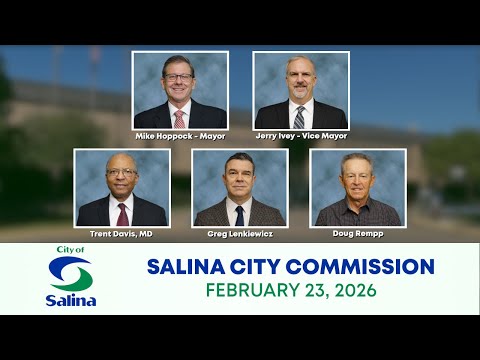
The Salina City Commission declined to approve a resolution Feb. 23 that would have advised issuance of industrial revenue bonds and allowed a sales‑tax exemption for the Kansas Municipal Energy Agency (KMEA) to construct a new Salina facility.
City staff and KMEA representatives described the project as three buildings (an 8,500‑square‑foot office/line shop, a 4,850‑square‑foot fabrication shop and a 4,500‑square‑foot cold storage building) on a parcel the agency recently acquired. KMEA currently employs about 20 people in Salina and said it expects modest growth — roughly two employees per year over the next five years — driven by demand for line work and related services.
Mitch (city staff) summarized the financial terms: "All the company is asking for is sales tax, the abatement on the sales tax for the project, which is estimated to be about a quarter of $1,000,000," meaning an estimated cumulative sales‑tax exemption of about $250,000; staff estimated the city's portion would be roughly 13–15% of that total (about $34,000).
Commissioners pressed KMEA and bond counsel about several points: whether the $250,000 figure reflected materials only (bond counsel Sarah Steele explained the exemption applies to taxable construction materials and labor is already exempt), how much of the projected investment was construction versus equipment and land, and whether approving the exemption would set a precedent for other not‑for‑profit municipal agencies. Several commissioners said their preference in prior abatements had been projects that later produced property tax receipts after abatement periods; because KMEA is structured as a municipal/nonprofit entity it will not generate future property tax revenue, which some commissioners listed as a reason for concern.
After discussion a commissioner moved to approve resolution 26‑8336. The motion carried in committee but, at the commission, the motion to approve the resolution failed 2–3. The presiding officer said he voted against the resolution because he was concerned the city would forgo sales tax now without property‑tax revenue later and because approval might lower the bar for future abatements. "That fails 2 to 3," the chair said.
Next steps: The applicant said the project will proceed regardless of local sales‑tax assistance; KMEA representatives said the abatement only lowers construction costs and the facility may still be built without the exemption.