
Committee Hears H.697 to Create 25‑Foot Buffer Around First Responders; Fraternal Order of Police Backs Measure
Get AI-powered insights, summaries, and transcripts
Sign Up Free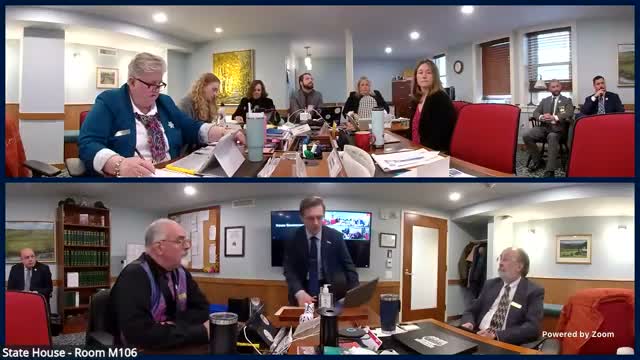
Summary
Lawmakers and witnesses reviewed H.697, which would make it a misdemeanor to intentionally come within 25 feet of a first responder during an acute public‑safety emergency. Counsel and the Vermont FOP discussed definitions, application to journalists, and existing statutory gaps; no vote was taken.
The House Government Operations & Military Affairs committee on Thursday heard testimony on H.697, a bill that would make it unlawful for a person to intentionally remain or come within 25 feet of a first responder during an acute public‑safety emergency.
Tim Devlin, legislative counsel, read the bill’s core language to the committee: "It is unlawful for a person to intentionally remain or come within 25 feet of [a] first responder during a public safety emergency," and said a conviction would carry up to 60 days in jail, a fine not to exceed $500, or both. Devlin said the bill as introduced sets an effective date of Jan. 1 (year not specified in testimony).
The measure defines "first responder" to include law enforcement officers certified by the Criminal Justice Council, firefighters as defined in statute and emergency‑medical personnel. Devlin told lawmakers the bill uses a fact‑dependent definition of "public safety emergency" — an "acute event in which a first responder must engage in the lawful performance of a legal duty to address an immediate threat to public health or safety" — and said the committee could add more detail if members find the phrase too vague.
Committee members pressed counsel on how the definition would operate in real time. Devlin said the question is "very fact dependent," giving hypotheticals such as a reckless, drunk‑driving stop that could qualify versus a routine speeding ticket that likely would not. He noted that the statute requires either: (A) the first responder verbally identifying themselves, or (B) a verbal warning not to approach, and (C) a culpable mental state tied to obstructing, threatening or harassing the responder.
Members also asked whether journalists would fall within the 25‑foot restriction. Devlin responded that the prohibition applies to any person but is conduct‑based: "a person" could be a reporter, "but then it's conduct dependent" — the person must have been warned or identified and must act with the intent to obstruct, threaten or harass. Devlin read the bill’s harassment definition as conduct that "would cause a reasonable person substantial emotional distress," and said whether newsgathering qualifies would be resolved on a case‑by‑case basis and could be litigated after the fact.
Representative Oliver, the bill sponsor, said the proposal was written with First Amendment concerns in mind and stressed the goal is to discourage people who "try to get into the middle and film an interaction, a very personal interaction," not to bar legitimate reporting. Oliver said, "25 feet with a camera and microphone usually still is pretty effective."
Joe Coro, president of the Vermont Fraternal Order of Police State Lodge, testified in support of H.697, describing recurring crowd‑interference incidents and staffing shortfalls that make early, narrowly tailored deterrence valuable. Coro said existing statutes such as the state anti‑obstruction law can carry felony penalties but in practice often apply only after a substantial interference has already occurred. "Impeding public officers" (testimony referenced the impeding statute) can be difficult to charge in early crowd scenarios, he said, and the proposed misdemeanor would be a more practical, proportional tool to prevent escalation.
Coro recounted a recent Chittenden County incident in an alley between Church Street and City Hall Park where two officers were trying to detain a suspect who reached toward a firearm while a crowd closed in. "That could have gone a lot of different ways," he said, arguing earlier deterrence could reduce the likelihood that routine encounters escalate to deadly force.
Coro recommended the committee consider alternate phrasing such as "call for service" instead of "public safety emergency," saying the bill largely targets routine calls where crowding interferes with response. Other members noted comparable laws in other states (one member cited Florida’s 25‑foot rule) and raised the option of tightening the statutory definition to reduce ambiguity for officers and the public.
No formal motion or vote occurred at the hearing. Members said they would consider the bill’s language and whether to fold parts of H.697 into a broader emergency‑response bill under committee consideration. The committee recessed for lunch and planned to resume at 1 p.m.