
Council rezones Reimer tract area to general industrial despite strong neighborhood opposition
Get AI-powered insights, summaries, and transcripts
Subscribe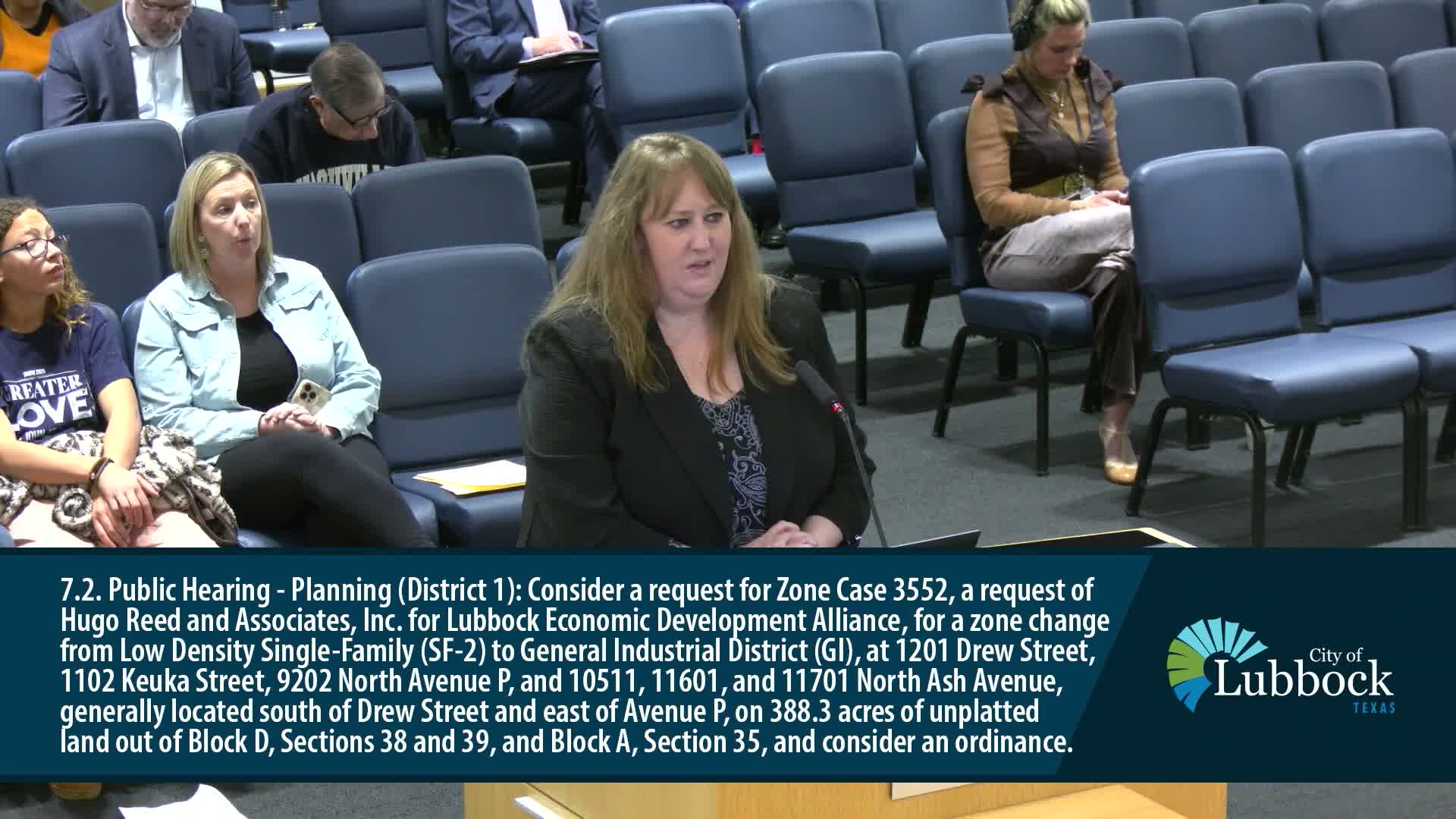
Summary
The council approved zoning case 3552 to change several parcels near Drew Street and FM 1294 to General Industrial (GI), a 7-0 vote after residents described anxiety, potential loss of homes and requests for delay while the developer works on acquisition plans.
The Lubbock City Council voted 7-0 to approve zoning case 3552, changing a collection of parcels near Drew Street and FM 1294 from low-density single-family (SF-2) to General Industrial (GI).
Applicant representative Terry Holman of Hugo Reed & Associates told the council the request covers three parcels and a large southern tract (the "Reimer Tract," described in the presentation as roughly 375 acres). Holman said the city's comprehensive plan designates the area for industrial use and emphasized the GI district's compatibility with rail-served industrial development. He also said substantial deed restrictions and setbacks proposed by the applicant would be recorded with Western Title if the rezoning were approved.
Several residents from a small row of homes along FM 1294 urged the council to postpone approval. William Whitworth and multiple family members described how the comprehensive plan and recent land purchases by a developer (identified in the hearing as Lita) had left them anxious about their children's stability and future, and asked the council to "vote no for now" so they could continue negotiating with the developer on acquisition or other accommodations.
"This is not an instance of just one industrial manufacturing business being placed next to a neighborhood," resident William Whitworth said during public comment. "This is an instance of a small group of houses ... being completely encased by an industrial district." Several family members, including teenagers who addressed the council, described anxiety and behavioral regressions they attributed to uncertainty about the future of their home.
Holman and planning staff countered that the property was annexed and that much of the surrounding area is already industrial or planned for industrial uses; Planning & Zoning had recommended approval by unanimous vote, and staff told the council deed restrictions and more stringent setbacks were included in the applicant's submission.
Council members acknowledged the difficult balance between neighborhood concerns and citywide planning goals but ultimately voted to approve the zone change. The council did not adopt any additional, council-directed acquisition or mitigation conditions at the time of the vote; councilmembers asked staff and the applicant to continue communications with affected residents.
Action: zoning case 3552 approved 7-0. The public hearing had spanned several hours and included multiple emotional appeals from affected homeowners requesting time to seek a compromise with the developer.