Get Full Government Meeting Transcripts, Videos, & Alerts Forever!
Get email alerts on the Energy Audit topic
No spam. Unsubscribe anytime.
Consultants present energy-efficiency audit to Edgerton council, recommend building and infrastructure upgrades
Summary
Consultants from Upper 90 briefed the City of Edgerton on an investment-grade energy audit funded by a March 2024 PSC grant, recommending building envelope fixes, HVAC upgrades, manhole lining and meter replacements; they asked the council to send measures to committees for budget and ROI review.
Mario Molonzi, a consultant with Upper 90, presented key findings from an investment-grade municipal energy audit to the City of Edgerton Common Council on Jan. 30, describing building- and system-level measures that consultants say could be implemented through performance-based contracting without seeking new operating dollars.
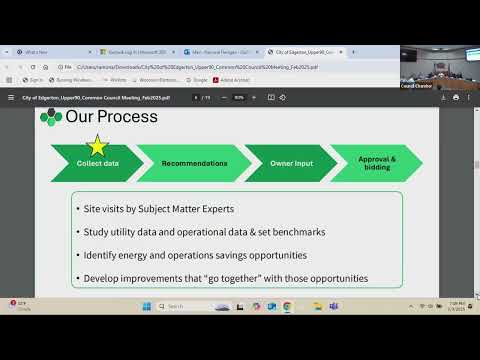
The presentation, funded through a March 2024 planning grant and building on prior work by Slipstream, covered data-collection methods, building envelope issues, HVAC concerns and citywide infrastructure opportunities. Molonzi said the audit is "well over halfway" complete and that the next meeting would present budgets and estimated savings so the council can assess return on investment.
Adam Prohaska, project engineer with Upper 90, highlighted building-specific fixes including destratification fans in high-ceiling public works spaces to mix heat more effectively, air-sealing and insulation at garage doors and roof-wall interfaces, and HVAC controls such as variable frequency drives for library pumps. Prohaska noted the library’s commercial boiler was installed in 2005, placing it near typical 20-year replacement timelines.
On infrastructure, consultants recommended targeted manhole sealing using a polymer spray liner (advertised with a 10-year limited warranty) to reduce inflow and infiltration (I&I) into the wastewater system and thereby lower treatment costs. Molonzi said consultants performed a cross-section analysis to estimate I&I and will return with more detailed budgets if the city chooses to proceed.
Consultants also reviewed the city’s water-meter inventory with staff (Tom and Wendy) and recommended replacing the oldest mechanical meters—some reportedly as old as 40 years—and retrofitting others with wireless reading technology to reduce revenue loss from under-reading.
Molonzi described the contracting approach as performance-based: "We’re looking to be able to implement these projects with no new dollars to an organization," he said, explaining that guaranteed savings or performance outcomes underpin the contract. He asked the council to route the measures to the Public Works Committee and the Utility Commission for owner input, budgeting and scheduling. Upper 90 estimated roughly 20 line items would be detailed at the next review.
Next steps: consultants will produce line-item budgets and savings estimates and coordinate follow-up workshops with staff and the Public Works Committee. Council members asked staff to schedule those committee meetings so that ROI and procurement options can be reviewed before any implementation decision.
Reported facts in this article are taken from the consultants’ presentation and council discussion; projected savings, final contracts and implementation timelines were not specified and will depend on committee review and future council action.