
Oklahoma Athletic Commission asks legislature for $300,000 supplemental and $500,000 recurring after becoming standalone agency
Get AI-powered insights, summaries, and transcripts
Sign Up Free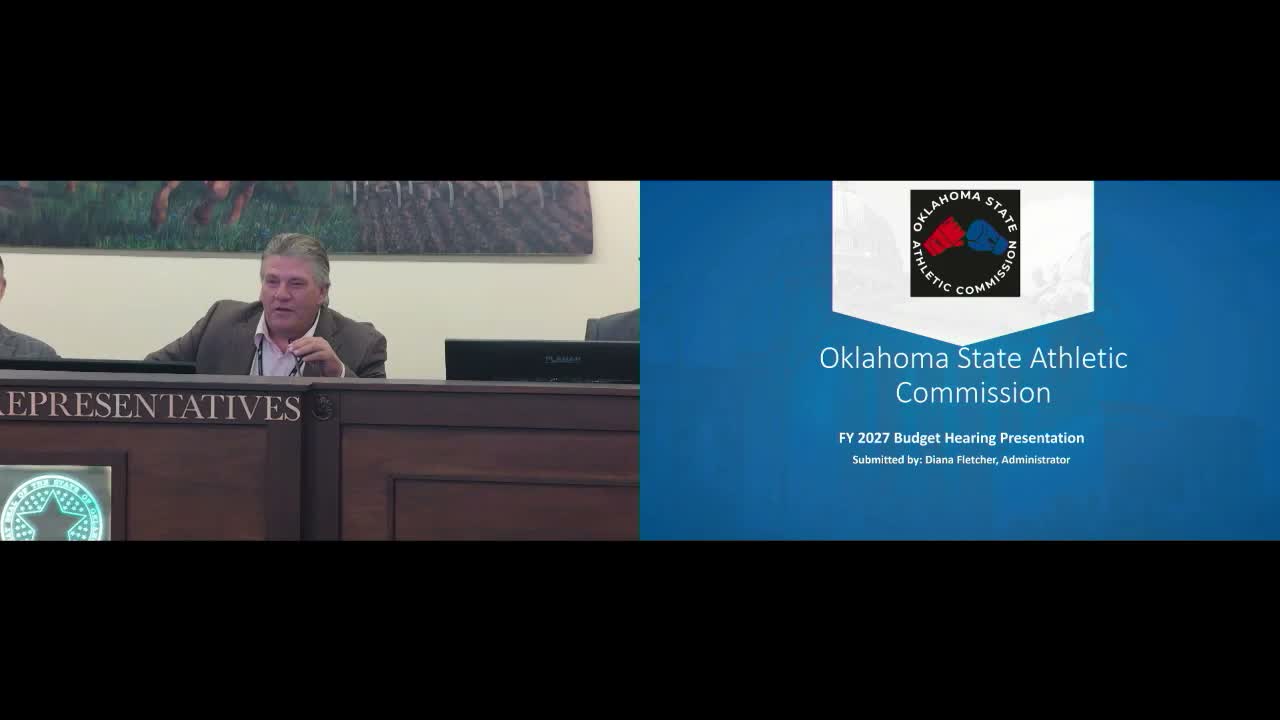
Summary
The Oklahoma State Athletic Commission told a House finance subcommittee it needs a $300,000 supplemental and $500,000 yearly recurring funding to cover startup costs, staffing and a licensing database after separating from the health department.
The director of the Oklahoma State Athletic Commission told the House finance subcommittee on Feb. 26 that the agency needs immediate and ongoing funding after becoming a standalone state agency.
The commission, which the director said was founded in 1999 and regulates boxing, mixed martial arts, kickboxing, Muay Thai, Brazilian jiu-jitsu, entertainment wrestling, slap fighting and bare-knuckle events in Oklahoma, asked the committee for a one-time supplemental of $300,000 and recurring annual funding of $500,000 to cover rent, utilities, contracted IT and HR services, licensing software and an additional staff hire.
The funding request followed the agency’s recent administrative separation from the state health department. The director said previously the health department received a $200,000 legislative earmark to cover the commission’s needs; now that the commission has its own agency number, it has broader, direct budget responsibilities. The director told the committee the commission’s current cash balance is about $150,000 and that it has contracted with OMS for HR, payroll and IT services.
“We have Excel. That’s our database,” the director said, describing the agency’s licensing system. She said the commission hopes to buy licensing software to better track officials and licensees.
On event volume and economic impact, the director said the commission licensed a total the transcript records as “12 87” participants for fiscal 2025, oversaw about 40 combat events in the year and that combined event sales were $3,133,519, producing what she described as an estimated jobs-related impact of “a little over $73,700.” (The committee did not clarify the transcript’s formatting of the participant count.)
The director emphasized staffing shortages: the agency currently has two full-time employees, with 17.68 FTEs reported on its books, six unfilled positions and roughly 36 temporary officials statewide who attend and inspect events. She said many officials pay their own costs to travel to regional or national certification events and that Oklahoma has not held an in-state official training since 2012. “The Association of Boxing Commissions will help pay for people to come in, to educate our officials here in Oklahoma,” she said.
Committee members probed operational details. One lawmaker asked whether promoters or the commission provide medical personnel and referees; the director replied that promoters typically pay for doctors, ambulances, referees and other event personnel but that everyone who works an event must be licensed by the commission.
On fees, Representative Leah noted concern about charitable events; the director said the statutory framework sets the fee as an assessment equal to 5% of sales and that the commission cannot unilaterally change that because it reflects existing legislation.
The director also described outreach to major promotions to grow the sport’s presence in Oklahoma and said she and staff recently attended industry events and joined the national association’s board to improve networking. The director told the committee representatives of the Ultimate Fighting Championship had indicated interest in Oklahoma.
Committee members questioned the timing of the supplemental request versus waiting for the next fiscal year. The director said she has a temporary staffer she would like to hire immediately and that early funding would allow the commission to purchase licensing software sooner; she also said the commission could operate through the current fiscal year without the hire but preferred to move sooner to address capacity constraints.
The hearing did not include a vote on the request. The committee concluded with the chair encouraging the director to coordinate with incoming committee leadership next year; the meeting adjourned without further action.
The commission’s request will proceed through the legislature’s regular appropriation process.