Retained actuaries and retirement funds report improved funding; actuaries caution against rushing to spend surpluses
Loading...
Summary
Retained actuaries for the Legislative Commission on Pensions and Retirement (LCPR) and executives from multiple statewide retirement systems reported improved funded ratios and strong investment returns, while urging caution about using pension surpluses and explaining new layered amortization transparency.
Retained actuaries and the state’s major public retirement systems presented a broadly positive funding picture to the Legislative Commission on Pensions and Retirement on Feb. 24 while underscoring the need for prudence.
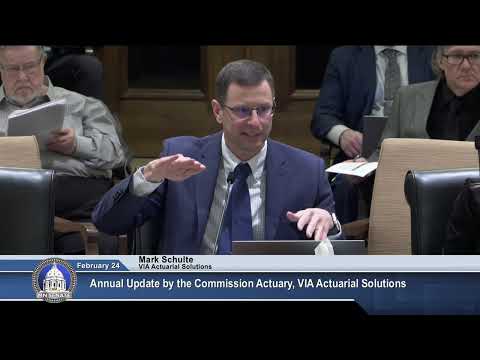
Via Actuarial Solutions’ Emily Knudson told the commission her firm replicated valuation results for several statewide plans and matched liabilities “within 1%” for both TRA and St. Paul Teachers, reinforcing the accuracy of current reports. Mark Schulte, also of Via Actuarial, outlined changes in amortization methods adopted after last year’s legislation and showed how layered amortizations now make clear which portions of unfunded liability are legacy balances, recent experience, or benefit-change impacts. Schulte used the MSRS general plan as an example, showing an initial unfunded liability of about $513 million at 06/30/2024 that grew to roughly $989 million by 06/30/2025 because of demographic losses and benefit changes.
Schulte warned that older long amortization schedules can produce negative amortization—initially allowing liabilities to grow—so the commission’s shift to layered amortization aims to reduce that effect and improve transparency. He also cautioned that when plans approach 100% funded status, policymakers face choices about whether to improve benefits or build conservative cushions: “Don’t necessarily immediately spend the pension surplus,” he said, urging validation of assumptions and discussion of long-term investment risk before making benefit changes.
System executives credited recent strong investment returns for much of the improvement. Aaron Leonard, MSRS executive director, said the State Board of Investment achieved a 10.9% return that materially helped MSRS results; MSRS’s general employees plan was reported at 98.4% funded on a market-value basis and projected to be fully funded by 2029. PERA’s leadership reported that all PERA plans are above 90% funded and described how market-value versus actuarial (smoothed) measures can differ: actuarial values still partially defer recent gains. TRA reported funding improvements to 81.6% on an actuarial basis and 84.5% on a market-value basis and showed sensitivity scenarios demonstrating how one very strong or weak year materially affects the date of full funding.
Speakers repeatedly emphasized that improved funded status does not eliminate long-term risk. Schulte and presenters urged careful review of assumptions, consideration of a funding cushion to protect against market reversals, and deliberate timing of any benefit changes so that they do not jeopardize younger participants’ security.
The commission took no formal policy votes on benefit changes at the meeting and adjourned after hearing reports from all major plans. The next LCPR meeting is scheduled for March 3, when the panel expects to hear a bill proposed by the state auditor regarding fire relief.