Get Full Government Meeting Transcripts, Videos, & Alerts Forever!
Get email alerts on the Tax Increment Financing topic
No spam. Unsubscribe anytime.
State Auditor presents 2024 TIF report to Senate Taxes Committee; highlights revenue, early decertifications and new dashboards
Summary
The Office of the State Auditor told the Minnesota Senate Taxes Committee that 2024 saw $261 million in tax increment, growing slightly from 2023, while new TIF certifications fell and many districts are decertifying early; the office unveiled interactive dashboards to help lawmakers and local officials inspect TIF activity.
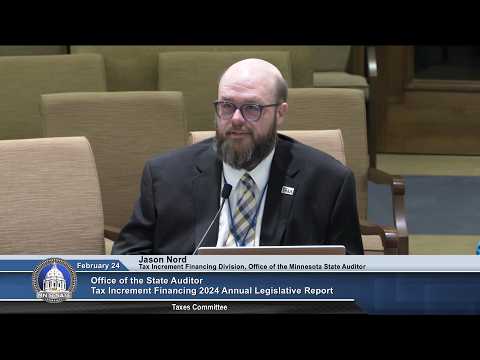
The Minnesota Senate Taxes Committee received the Office of the State Auditor's 2024 Tax Increment Financing (TIF) Annual Legislative Report on Feb. 24, 2026, with Jason Nord, director of the OSA's TIF Division, detailing statewide use, revenues and new public dashboards.
Nord told the committee that TIF captures new property value for the life of a district rather than adding it immediately to the tax base, and that the tool's value depends on how it is used. "TIF is not a tool that's inherently good or inherently bad," he said, adding that it is useful when a project would not happen but for the assistance.
The report, Nord said, covers 373 TIF authorities and 1,657 reporting districts in 2024. "There are $261,000,000 of tax increment for 2024," he told the committee, and almost 80% of that revenue is generated in the metro area. He also said $16,800,000 of tax increment was returned in 2024; returned increment is redistributed to the county, city and school district where the TIF district is located.
Nord described debt and risk allocation across districts: "There is $1,900,000,000 of TIF debt for 2024," he said, and 73% of that is in pay-as-you-go notes that reimburse developers from property tax payments as they occur, placing much of the development risk on developers rather than on taxpayers.
Committee members pressed Nord on several trends. In response to a question about why new certifications have declined in recent years, Nord said he had no special insight but speculated that higher interest rates and economic uncertainty could be delaying projects. He highlighted an ongoing shift toward early decertification: in recent five-year windows roughly 72–73% of housing and redevelopment districts decertified early, and those that decertified early did so on average about 10 years sooner than their maximum duration.
The OSA also announced six interactive dashboards on its website for compliance and TIF mapping, built with University of Minnesota assistance. Those dashboards, Nord said, let users zoom to authorities, inspect counts and view district-level details. When the committee chair asked whether generative AI was used to build the tool, Auditor Blaha replied, "This is not... no generative AI is necessary for this."
Nord and senators also discussed nuances such as pooling (using excess increment from one district to assist other projects), special uncodified districts created by bespoke legislation, and how municipalities and developers negotiate which public improvements developers must pay for. Nord described those determinations as largely negotiable and dependent on local leverage.
The OSA made the report and its underlying data available and invited committee members to review the dashboards and suggest enhancements. The presentation concluded and the committee moved on to a bill related to excess increment reporting.