Get Full Government Meeting Transcripts, Videos, & Alerts Forever!
Get email alerts on the Immigration‑enforcement‑access topic
No spam. Unsubscribe anytime.
Maine judiciary committee narrows bill limiting voluntary cooperation with immigration enforcement in schools, libraries and state institutions
Summary
The committee advanced an amended LD 2106 that requires the attorney general to publish model policies limiting voluntary consent to let immigration officers into nonpublic areas of public schools, state institutions and public libraries, while making guidance optional for many private entities; committee members debated constitutional preemption and implementation timelines before the motion carried 6‑5.
The Joint Standing Committee on the Judiciary advanced LD 2106 on a 6‑5 vote after the sponsor and staff substantially narrowed the bill to address federalism concerns.
Legislative analyst Janet Stoekel told the committee that portions of the original draft could be vulnerable to challenges under the Supremacy Clause and the intergovernmental‑immunity doctrine, particularly where the draft would have restricted private entities’ voluntary cooperation with federal immigration enforcement. "At least one federal court has concluded that a state law restricting a private entity's cooperation with federal immigration enforcement ... likely violates the intergovernmental immunity doctrine," Stoekel said, warning the panel that penalties or disciplinary schemes aimed only at entities that cooperate with federal authorities could be struck down.
To respond, the sponsor's amendment requires the Maine attorney general to publish model policies and guidance (the amendment keeps an emergency clause but otherwise replaces the bill). Under section 1, the attorney general must publish mandatory model policies for specified public entities no later than 60 days after the law takes effect and may update them biennially; affected facilities would have three months to adopt the model policy or an equivalent. The mandatory list covers public schools (with education records defined by FERPA), public post‑secondary institutions, state institutions (specifically naming Dorothea Dix and Riverview), and the Maine State Library and other enumerated public libraries. "So this proposed amendment would replace the bill," Stoekel said while walking the committee through the draft.
Private entities named in the amendment — private schools, private health‑care facilities, community residential programs, child‑care providers and houses of worship — are placed in an optional category: the attorney general may publish guidance they can adopt, but those entities would not be required to do so. The attorney general’s office asked the committee to anticipatively allow a single model document with a clear disclaimer identifying which institutions are mandated and which are optional so the office could avoid issuing separate templates for each entity type.
Members pressed staff on implementation and enforcement. Stoekel said the bill does not specify criminal penalties for violations but noted several possible avenues the committee should consider: default penalties under Title 22, administrative licensing discipline for state‑licensed facilities or professionals, and employer discipline. "Because these potential penalties could be interpreted as inflicting a burden on those private employers and employees who acquiesce in a federal investigation ... it’s possible that the provisions of the bill affecting private entities could be found to violate the intergovernmental immunity doctrine of the supremacy clause," Stoekel said.
The amendment includes a "good faith" exception protecting individuals acting on behalf of institutions before model policies are adopted or required. For public schools and state institutions, the draft also says that if federal law requires inspections or interviews in a particular location (including I‑9 employment‑verification inspections), the institution must designate a nonpublic area for those activities and allow necessary access.
Alicia Ray, a policy fellow at the ACLU of Maine, told the committee that school resource officers are contracted through local law‑enforcement agencies and likely fall within the bill’s law‑enforcement definition. She recommended that AG guidance encourage memoranda of understanding between police departments and school units to make the boundary clear.
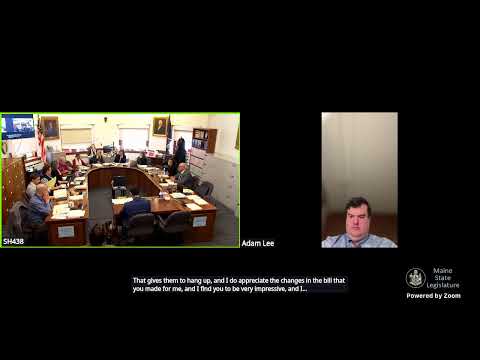
Sen. Rachel Talbot Ross moved the committee "ought to pass as amended" (the salmon‑colored amendment); Representative Dylan Pugh seconded. The clerk read the roll call; the tally recorded six members in favor, five opposed and three absent. The chair closed the LD 2106 work session and scheduled further work later in the day.
The committee’s amendment focuses required rules on public institutions while giving private entities an option to adopt the AG’s model policy; it retains exceptions for court orders and other state or federal law. The record does not specify final penalty amounts or an exhaustive list of licensing sanctions; the committee discussed — but did not adopt — express prohibitions on licensing discipline for specific professional boards. The work session is closed and the sponsor may pursue final drafting changes before subsequent committee steps.