Get email alerts on the Law Enforcement Accountability topic
No spam. Unsubscribe anytime.
Oregon House passes Law Enforcement Accountability and Visibility Act after contentious debate
Summary
House Bill 4,138, requiring visible officer identification, narrowing facial-covering use, and limiting assistance to certain federal operations, passed the Oregon House on Feb. 24 after hours of debate over constitutionality, operational impacts and litigation risk.
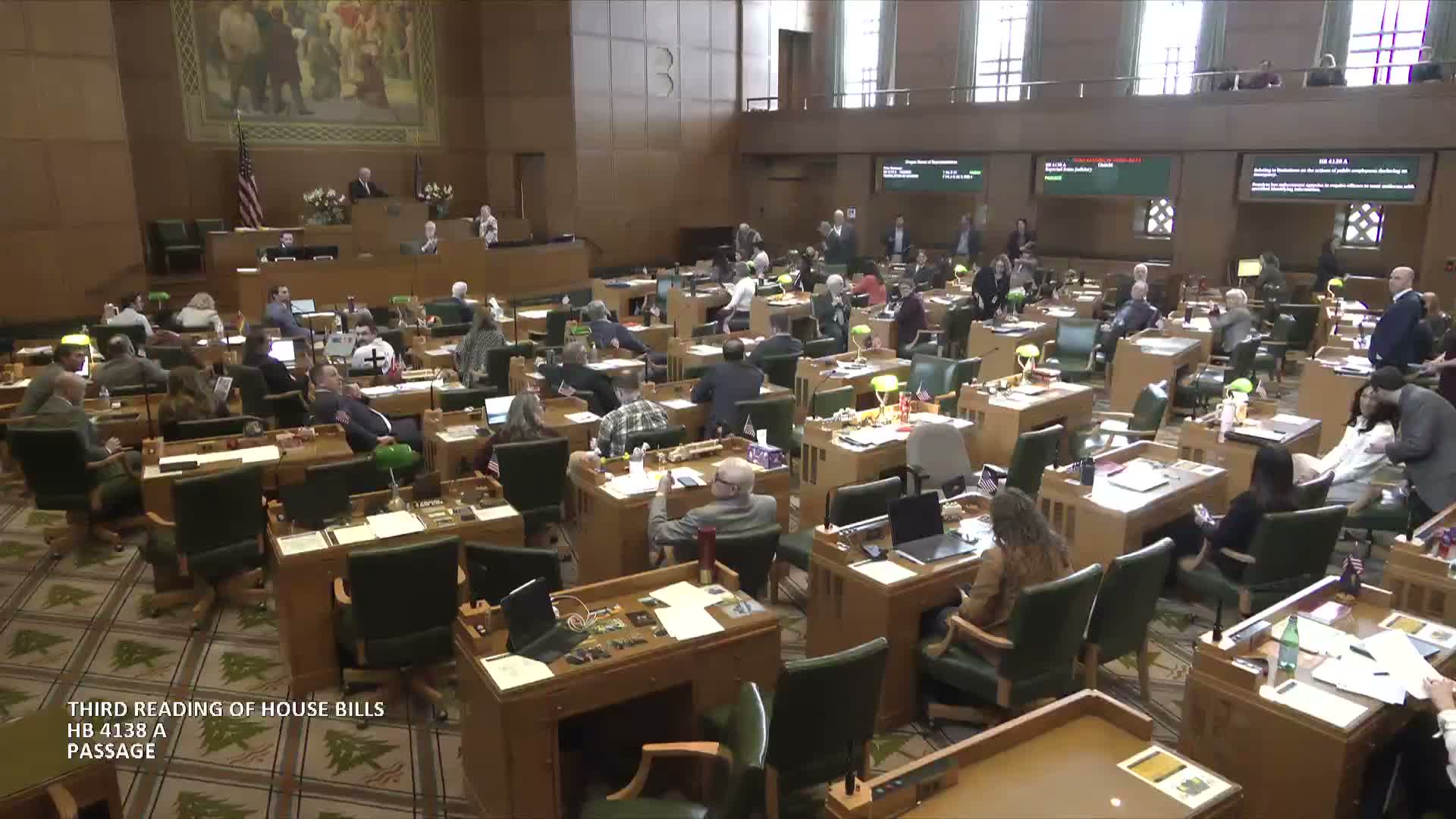
SALEM, Ore. — After hours of floor debate, the Oregon House on Feb. 24 passed House Bill 4,138, the Law Enforcement Accountability and Visibility Act, which establishes statewide minimum standards for officer identification, restricts identity-concealing facial coverings with narrow exceptions and limits certain cooperation with federal or out-of-state law enforcement in cases implicating protected speech or discrimination.
Sponsor Representative Chi Chi framed the bill as a safeguard for public trust and safety: "When someone has the power to stop you, question you, detain you, or arrest you, you deserve to know who they are and who they work for," she said, describing identification and policy-posting requirements and a prohibition on facial coverings while officers are performing duties near ballot drop sites and ballot-marking areas.
Supporters—including Representatives Tran, Munoz and Chotzin—said the measure was negotiated with law enforcement stakeholders, included practical exceptions for undercover and tactical operations, and created an optional attestation pathway to allow lawful cooperation with outside agencies when constitutionally appropriate.
Opponents warned the bill could create legal and fiscal risks for local governments and hamper operational cooperation. Representative Bobby Levy argued it "creates legal conflict, operational confusion and financial liability for our local governments," pointing to preliminary litigation in other states over similar measures and the potential for injunctive relief to increase local legal costs. Several rural representatives—among them Mannix, Juncker and Boyce—said unpaid compliance costs and litigation exposure could strain small county sheriff's offices.
Lawmakers also debated whether the measure runs afoul of federal supremacy. Supporters said the bill applies uniformly to all law enforcement in the state (not only federal officers) and pointed to recent federal-court rulings in other jurisdictions as supportive of the approach when applied equally.
A procedural motion to refer the bill to the Committee on Ways and Means for a fiscal review failed to obtain the required majority. After final remarks, the clerk announced that House Bill 4,138 had "received the constitutional majority" and was declared passed. The transcript does not contain a complete roll-call tally in the floor record provided.
What happens next: HB 4,138 will go to the Senate for consideration. Supporters characterized the act as a step toward clearer accountability and visibility; opponents signaled continuing concern about constitutional exposure, implementation costs for local agencies and operational impacts on rural law enforcement.
AI generated
The text on this page is AI generated. Summaries, highlights, analysis, and video transcripts are all produced from the original source material.
AI can make mistakes, so if you spot one, and we will fix it for everyone.
Note: the source content is unaltered by us. Any content source we link to, be it a video, an audio recording, or a document, is presented exactly as its publisher released it. That publisher is usually a government body, sometimes an individual official or another organisation.