Get Full Government Meeting Transcripts, Videos, & Alerts Forever!
Get email alerts on the Panama Canal Security And Trade topic
No spam. Unsubscribe anytime.
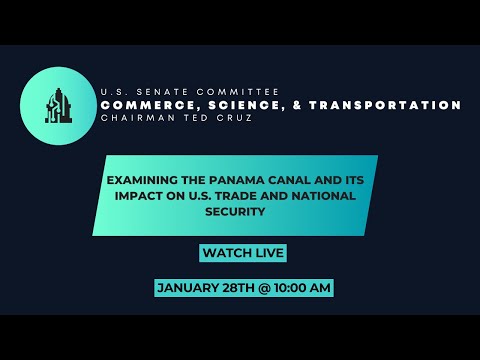
Senate hearing spotlights Panama Canal risks: auctioned transit slots, Chinese-linked port concessions and treaty questions
Summary
Federal regulators, a maritime-industry leader and a legal scholar told the Senate Commerce Committee that drought-driven slot auctions, rising fees and Chinese-linked port concessions have strained the Panama Canal and raised questions about treaty neutrality and U.S. policy responses.
WASHINGTON — Federal Maritime Commission officials, shipping-industry executives and an international-law professor told the Senate Commerce Committee that the Panama Canal’s recent operational changes and growing Chinese-linked investments pose urgent commercial and legal problems for the United States.
Chairman Luis Sola of the Federal Maritime Commission described drought-driven operational shifts last year that forced transit restrictions and the auctioning of transit slots, saying the canal’s resilience and the independent role of the Panama Canal Authority (ACP) are now matters of close U.S. scrutiny. “The Panama Canal is vital to our economy with over 75% of its traffic bound for our ports,” Sola said in his opening remarks.
Commissioner Daniel Maffei, who accompanied Sola on a July 2024 fact‑finding trip to Panama, told senators that the canal used auction procedures during the 2023 low‑water period and that the resulting market allocation produced significant complaints from shippers. “We got a lot of complaints from LNG carriers that paid $4,000,000 to go through,” Maffei said, adding that auction revenue had increased substantially and that the commission continues to monitor whether those practices disadvantage U.S. trade.
Joe Kramick, president and CEO of the World Shipping Council, testified on commercial impacts: reduced allowable draft and fewer daily transits can force ships to carry fewer containers and increase voyage times and costs. He said the recent water‑level limits led to roughly a 10% reduction in import volumes for some Gulf and East Coast ports during the constraints.
The committee also focused on the legal framework that governs the canal. Law professor Eugene Kantorovich reviewed the 1977 treaty concerning the permanent neutrality and operation of the Panama Canal, emphasizing key provisions requiring the canal to be open to all nations, charging “just, reasonable, equitable” tolls, and vesting operation in the Republic of Panama. Kantorovich said these provisions raise difficult fact‑intensive questions about when foreign commercial arrangements become inconsistent with the treaty. He warned the treaty’s ratification history contemplates a range of U.S. responses and that, in extremis, the parties understood some unilateral measures could be taken to protect neutrality.
Senators repeatedly pressed witnesses about two port concessions awarded in 2021 to a Hong Kong‑linked operator (identified in testimony and media reports as Hutchison/Hutchinson) and whether those deals—some awarded without competitive rebidding—create de facto foreign influence at the canal’s approaches. Witnesses described a Panamanian comptroller’s audit of the concessions and said Panama’s government and Canal Authority have answered many FMC questions, though concerns persist about whether subsidized foreign bids undercut U.S. firms.
Members of the committee from both parties urged greater U.S. investment to counterbalance foreign actors. Several senators and witnesses pointed to financing gaps in U.S. tools such as the Export‑Import Bank and the U.S. Development Finance Corporation as barriers to deploying competitive infrastructure funding overseas, and urged faster staffing of the U.S. embassy in Panama so Washington can better engage on these issues.
On remedies, Kantorovich noted a range of options—economic measures, conditioning of aid or investment, and other countermeasures short of force—and cautioned outright cancellation of the 1977 treaty would not automatically reverse the transfer of sovereign control that occurred when the canal and its adjacent territory were returned to Panama. FMC members echoed that the commission has statutory tools to investigate and, in some circumstances, take action under the Merchant Marine Act, though they said more information would be necessary before pursuing aggressive countermeasures.
The hearing also covered security and illicit‑trade concerns: witnesses recounted Panama’s recent improvements to the deflagging process for vessels suspected of sanction evasion (53 vessels were deflagged after recent reforms), and senators raised the risk that port‑side surveillance, cyber vulnerabilities or sabotage could harm transit operations.
Senators requested additional data for the record, and the witnesses agreed to provide follow‑up answers. The hearing concluded with an admonition from members on both sides of the aisle that the United States should consider a coordinated maritime strategy—covering investment, legal tools and diplomatic engagement—so that Panama’s canal remains reliable and consistent with U.S. commercial and security interests.