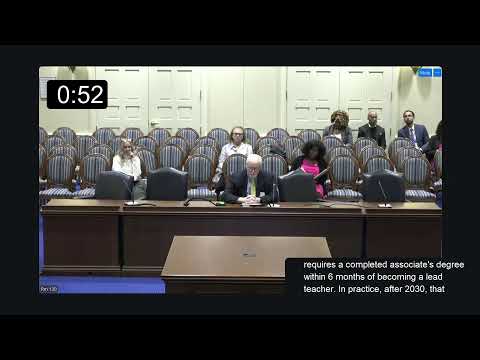
Ways and Means reviews a raft of education bills on Feb. 25, 2026
Loading...
Summary
The committee took testimony on numerous K–12 education bills ranging from teacher-prep and classroom time to school safety, open enrollment, water-safety curriculum, and a proposed statewide financial-literacy graduation requirement.
ANNAPOLIS — In a long February hearing focused on education policy, Maryland’s House Ways and Means Committee heard testimony on a slate of bills addressing school safety, teacher preparation, student access and school governance.
Highlights from the Feb. 25 hearing:
- HB 781 and HB 868 (Delegate Conaway): Two bills would introduce instruction about the collateral consequences of criminal convictions into middle‑school grades (statewide and a Baltimore City–focused variant). Conaway framed the measure as preventive legal education; committee members asked whether city school boards had been engaged and raised concerns about the evidence base for curricular mandates.
- HB 803 (Delegate April Miller): Sponsor proposed recalibrating the Blueprint’s classroom/collaborative time split to 80/20 (more classroom time) to address staffing shortages and reduce reliance on conditionally licensed teachers. Members noted recent MSDE vacancy data and asked about scheduling impacts in period‑based secondary schools.
- HB 856 (Delegate Ebersole): Would require local education agencies to use the NASDTEC educator clearinghouse when making offers of employment to surface disciplinary flags across jurisdictions. Testimony described how this complements existing background checks and fingerprinting.
- HB 837 (Delegate Ebersole): Seeks to strengthen cardiac screening and emergency response in school sports physicals; the American Heart Association, family advocates and cardiology experts supported cardiosafety measures while discussing how follow-up evaluations would be handled by clinicians and schools.
- HB 1000 (Delegate Alethia McCaskill): Part of the LEAD Act series, it would expand required school mapping data to include labeled features within a one‑mile radius (roads, water, hazards) to aid first responders searching for students who elope from campus; sponsors cited research on elopement and drowning risk among some autistic children.
- HB 26 (Delegate Karen Toles): Proposes open-enrollment pathways (sponsor is preparing amendments to limit transfers to within a child’s county); panelists emphasized transportation, capacity and equity concerns and discussed voluntary, intra‑district amendment options.
- HB 73 (Delegate Karen Toles): Would require the State Board to develop water-safety and introductory swimming standards for K–8; witnesses highlighted equity gaps in swim access and models that can deliver land‑based and pool-based lessons through community partnerships.
- HB 943 (Delegate Cathy Forbes): Would establish a standalone high‑school financial‑literacy requirement for graduation beginning with the class of 2030; testimony from nonprofit curriculum providers, student advocates and county officials emphasized wide availability of free curricular resources and teacher training, and argued the change would reduce disparities tied to ZIP code.
- HB 748 (Delegate Bernice Merrick North): Would make the early‑childhood career-ladder framework for private publicly funded pre‑K providers sustainable by tying qualification timelines to date of hire and using 3‑ and 6‑month windows rather than fixed calendar deadlines.
Committee members did not take final votes on these bills during the session. Sponsors generally requested favorable reports; the committee paused repeatedly for questions on implementation details, fiscal notes and how state and local authorities would coordinate. Several witnesses emphasized implementation flexibility (e.g., embedding water-safety lessons within health or PE courses, or allowing districts to decide which teachers deliver financial‑literacy instruction after professional development).
What’s next: Committee staff and sponsors will likely refine amendments and the committee will schedule additional work sessions or votes as the session progresses.