Get Full Government Meeting Transcripts, Videos, & Alerts Forever!
Get email alerts on the Data And Coordination topic
No spam. Unsubscribe anytime.
FERC technical conference spotlights data gaps and interagency coordination to curb utility‑caused wildfires
Summary
At a FERC technical conference (docket AD25‑16), federal agencies, state regulators, utilities and vendors called for secure sharing of power‑line location data, a national ignition/near‑miss reporting approach, and coordinated standards to speed mitigation while limiting costs.
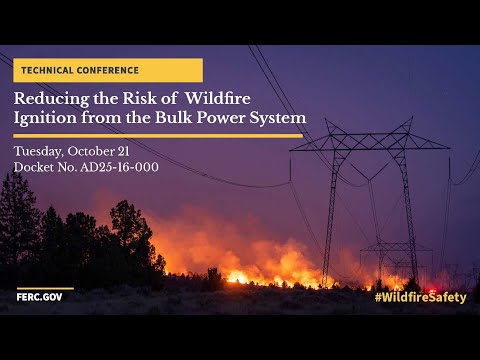
The Federal Energy Regulatory Commission convened a technical conference to identify cost‑effective practices to reduce wildfire ignitions from the bulk power system and to coordinate action under Executive Order 14,308.
Deputy Director Deepak Ramlachan opened the session, saying the goal was “to discuss cost effective best practices to reduce the risk of wildfire ignition from the bulk power system.” Chairman Rosner told attendees he had asked NERC to prepare a comprehensive best‑practices guide by May 2026 and described FERC’s role as a convener to decide whether new reliability requirements are needed.
Federal land and resource officials and utilities agreed that gaps in ignition reporting and asset location data limit effective prevention. Katie Jeresa, Assistant Secretary for Electricity at the Department of Energy, said there is “currently no central database for ignition reporting,” and speakers described inconsistencies in cause codes and lengthy investigations as obstacles to learning from near misses.
USDA and Interior officials said secure access to accurate bulk power line location data would allow pre‑season planning and better incident response on federal lands, but they acknowledged security and Critical Energy Infrastructure Information (CEII) constraints. Panelists proposed options including limited‑access repositories, memoranda of understanding, or DOE/national‑lab hosting to enable sharing while protecting sensitive information.
State regulators urged that reporting be structured to allow protected near‑miss submissions to promote a safety culture that yields root‑cause analysis without immediate punitive consequences. Several panelists pointed to existing state reporting (for example, California and Oregon) and industry voluntary programs as starting points but said broader national coordination was needed to support rigorous modeling and rapid dissemination of lessons learned.
Commissioners closed the panel by asking agencies and industry to pursue practical steps on secure data sharing and the ignition reporting framework, and they invited written comments to docket AD25‑16.
The conference continues with a second panel on monitoring technologies and cost recovery.